Home / Cabinet hardware
Cabinet hardware - the fittings behind every door and drawer.
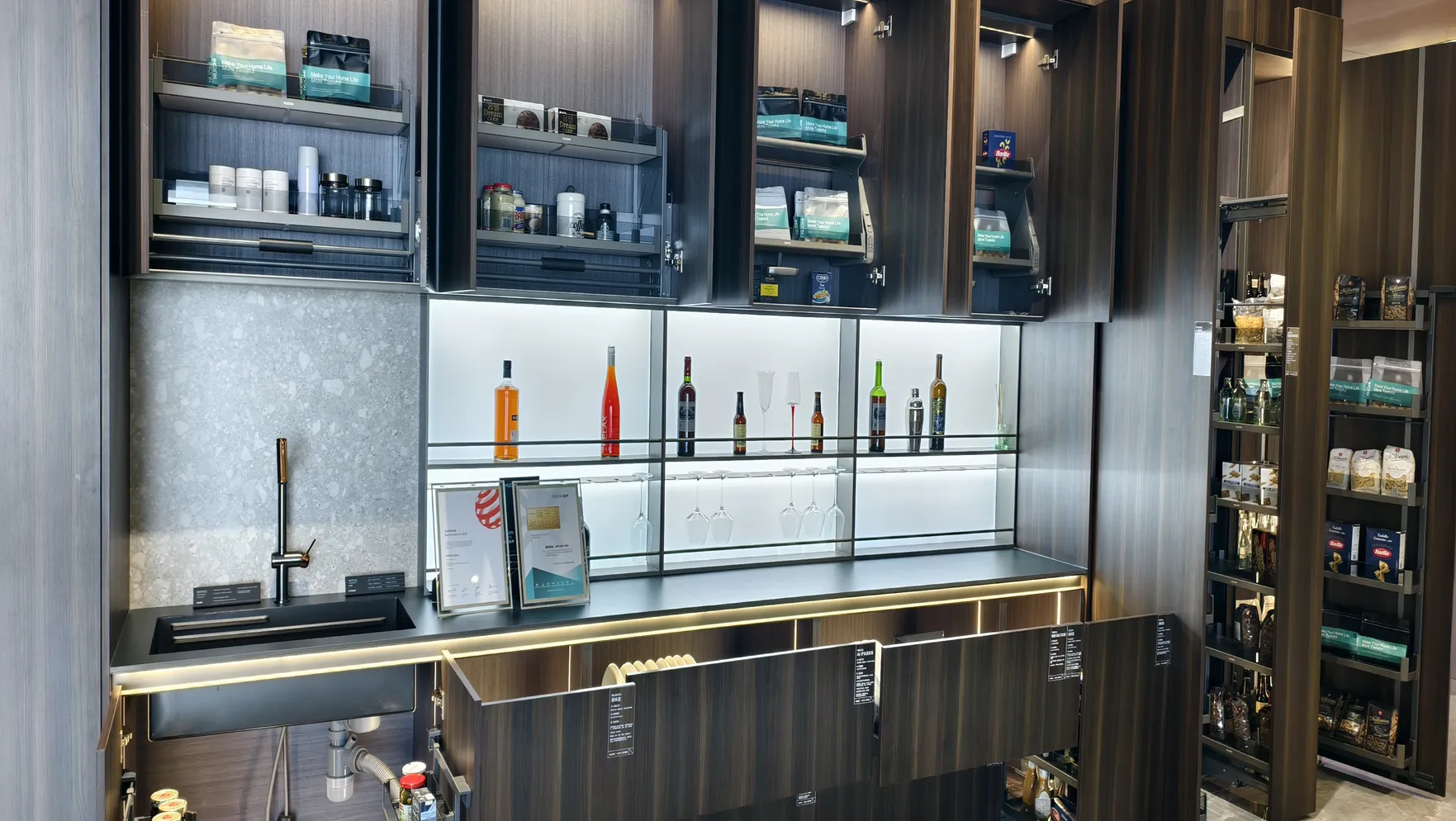
A cabinet is only as good as what moves it. The wall in our Foshan showroom runs hinges, runners, push-open and baskets in working order - everything on this page is photographed there, on the same standard that ships in your boxes.
The standard
The rating is on the spec sheet, not the brochure.
Most hardware disputes start after installation: the door that drops a millimetre a month, the drawer that binds at full extension, the push-open that gives up in year two. The way to end that class of problem before the container leaves Foshan is a single written standard - a cycle rating for the hinge, a load rating for the runner, a load rating for the door - and a warranty number behind all three.
Ours is the same standard on every collection, from a single bath vanity to a whole-home program, so the box, the door and the fitting are engineered against the same numbers. When your spec calls for a different system, we build to it - the numbers just move, they don't disappear.
- HingesSoft-close, rated at 50,000 cycles - DTC on request
- RunnersFull-extension, 35-45 kg per pair
- Door loadSingle door up to 28 kg
- Warranty5-year hardware warranty, aligned with the hinge manufacturer's
- Board18 mm E0 plywood, ≤0.05 mg/m³ (GB/T 39600, report SQ2405393) - certificates
- MOQMixed orders from 1,500 sq ft - no minimum at the sample stage
- Lead10-14 days factory; DDP 18-22 US West, 32-40 US East, 15-20 Sydney
- BasketsCutlery, corner, dish and tower systems - the full line
Hinges
Cup hinges, on the wall and in the box.
The hinge is the one fitting you never see working, which is exactly the problem with cutting cost on it. A hinge rated at 50,000 cycles does not fail at 40,001 - it wears, and the wear shows as a door that sits a millimetre proud of its neighbour, then a drop line that no longer meets, then a door that has to be lifted. On a 48-inch shaker in matte lacquer, that drift is visible from across the kitchen, and it is the first thing a walk-through client notices, long before any finish or hardware choice on the spec sheet.
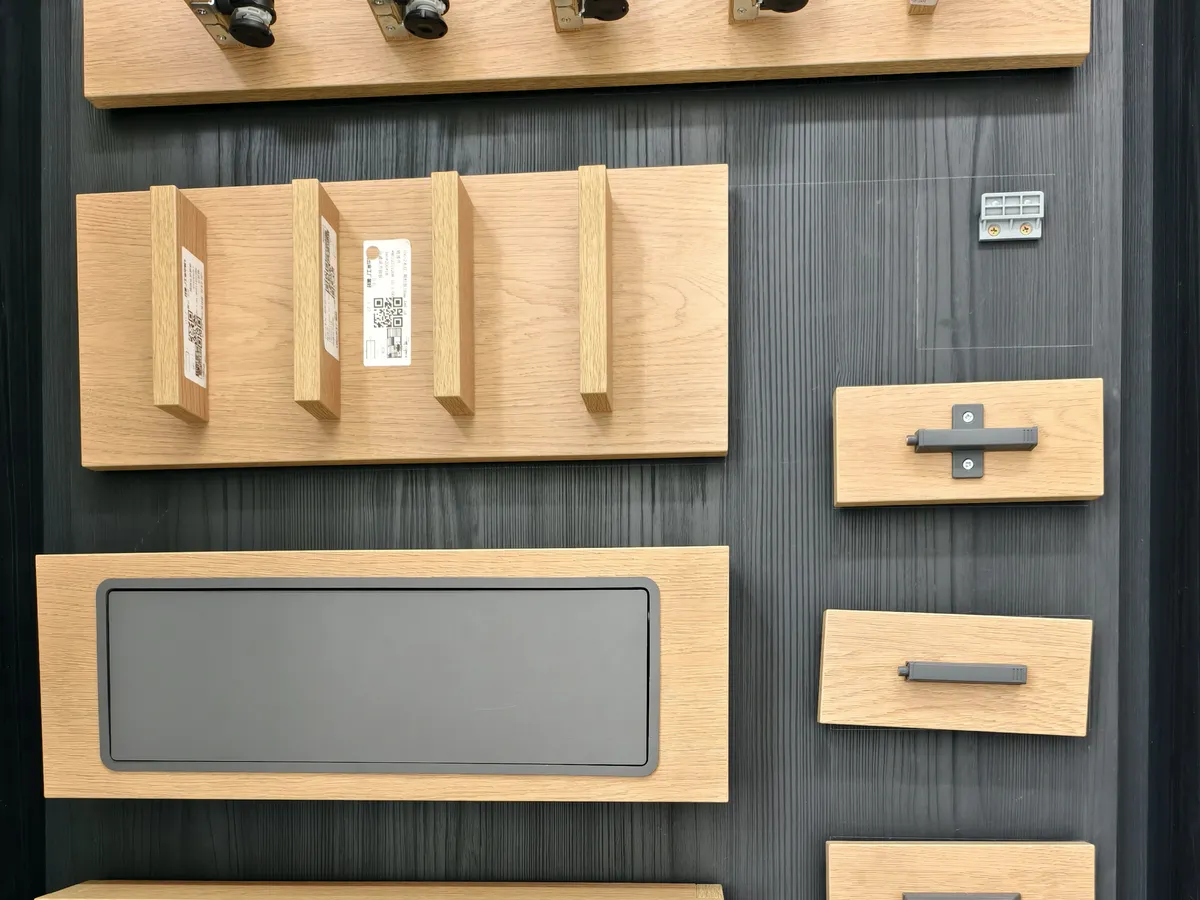
Every hinge on the wall above is the same class: soft-close as standard, the damper integral rather than an add-on, and the mounting plate sized so a door can be swapped without chasing screw holes. Factory QC includes a full open-close cycle on every door before the box is wrapped, so the rating is something the line has already demonstrated, not something you take on faith at installation. The door load rating sets the rest of the arithmetic: a single door is built to 28 kg, and the hinge count and mounting plate size follow from that number on the production list, so a heavy painted slab is engineered before it is hung, not after.
Handles & push-open
Handleless is a hardware decision, not a style one.
A frameless run with nothing on the front looks simple and is quietly one of the most hardware-dependent ways to build a kitchen: every door and every drawer has to open on a push, and the reveal has to be tight enough that the push point is consistent across a row of fronts. That is the 1.5 mm laser-cut reveal from Flatstone, and it is why handleless runs quote against a hardware spec, not a handle price of zero.
Where a handle does sit, the board above is the working range: cup pulls, bar pulls and the push-open units themselves, each on its own test board so you can feel the force before it goes on the spec sheet. The push-open units are the same 50,000-cycle class as the soft-close hinges, and a painted sample of any finish ships with your first quote - the door sample wall is next door to this one.
Runners
Full extension, and the drawer that proves it.
The drawer is where a runner's rating becomes physical: at full extension the box is hanging on the runner alone, and the load on that runner is the drawer, its basket, and whatever a family actually stores. Our standard is full-extension runners at 35 to 45 kg per pair, soft-close, with the drawer front loaded to the 28 kg door rating so a heavy painted slab does not flex the rail at the back corner.
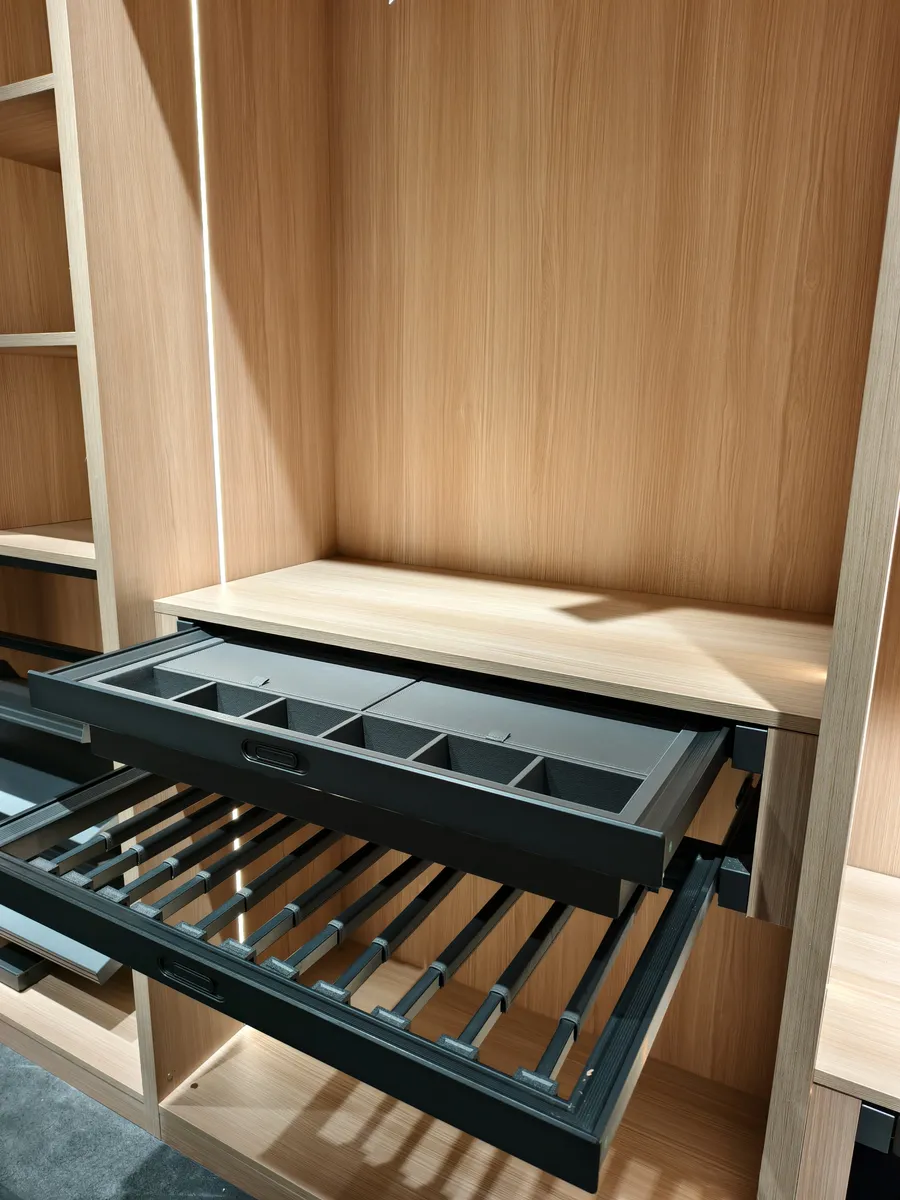
Both drawers in the pair below run on the standard line - the upper on the cutlery tray, the lower carrying the bottle rack - and the extension you see is the full run, with the box clear of the carcass. Soft-close is integral to the runner rather than bolted on afterwards, which is the difference between a drawer that closes quietly for a decade and one that starts knocking in year two. Undermount, concealed and clip-on variants sit on the same wall, and a spec that needs a different runner class is itemised on the production list, not absorbed into the base price.


Baskets
The basket line, on its own page.
Baskets are the largest single hardware family in a kitchen - cutlery trays, corner units, dish and drainer racks, spice towers, and the full-height pull-out tower that turns a tall box into usable storage floor to ceiling. Every unit in the line sits on the same full-extension soft-close runner standard as the drawers, powder-coated steel with the divider configuration matched to the drawer width, so a 450 mm and a 600 mm unit carry the same load rating.
The photographed range has its own page because it is the complete menu, not a highlight reel: pull-out baskets covers corner units, dish racks, drop-down shelves and the tall towers, each with the configuration it ships in. The runner standard is the same one the drawers in this section use, so a basket and the drawer beside it carry the same load rating and age the same way. The tray above is the standard cutlery unit in its most common spec - dark tray, wire dividers, full extension - and it is the unit most quotes start from.
Lift & drop-down
Wardrobes and tall units open downward too.
Drop-down and lift systems are where a wardrobe stops being boxes on runners and starts being furniture that works: the mirror panel that swings out from the carcass wall, the flip-down shoe shelf in a closed display, the lift shelf that brings a high row to working height on gas-assisted pistons. They are heavier hardware than a hinge - the mirror panel above carries its own counterweight - and the rating lives in the same place, on the spec sheet, per unit.
Both units are on the wardrobe wall in the showroom, in working order, and both are part of the made-to-order range rather than catalogue stock: the panel size follows the carcass, the finish follows the door, and the mechanism is selected to the load. The lift runs on gas-assisted pistons sized to the panel weight, and the rating is written on the spec sheet per unit - the same discipline the hinge and runner lines above follow. If your program is a rooming package or a walk-in closet, the closet pages show these systems installed in context.


The small end of the list
Concealed sockets, spin hangers and the parts underneath.
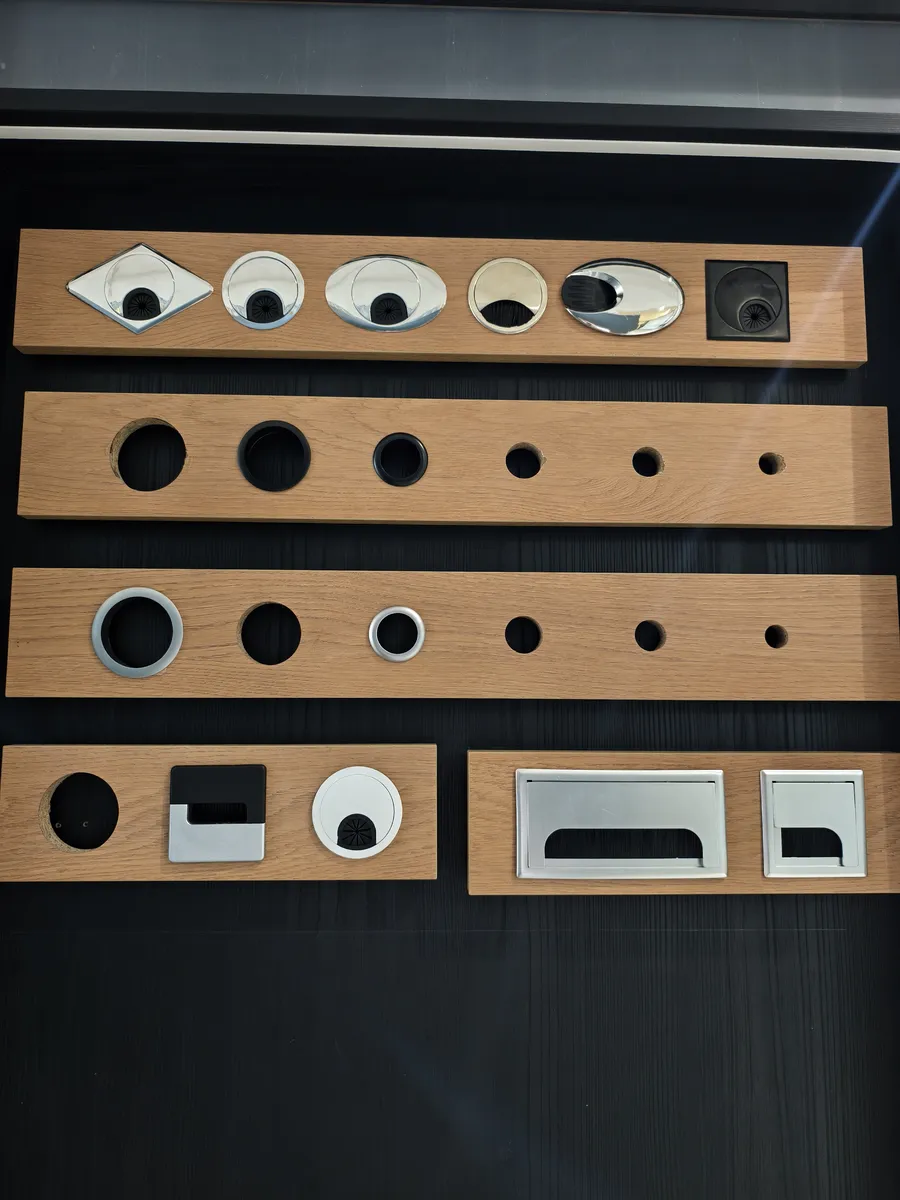
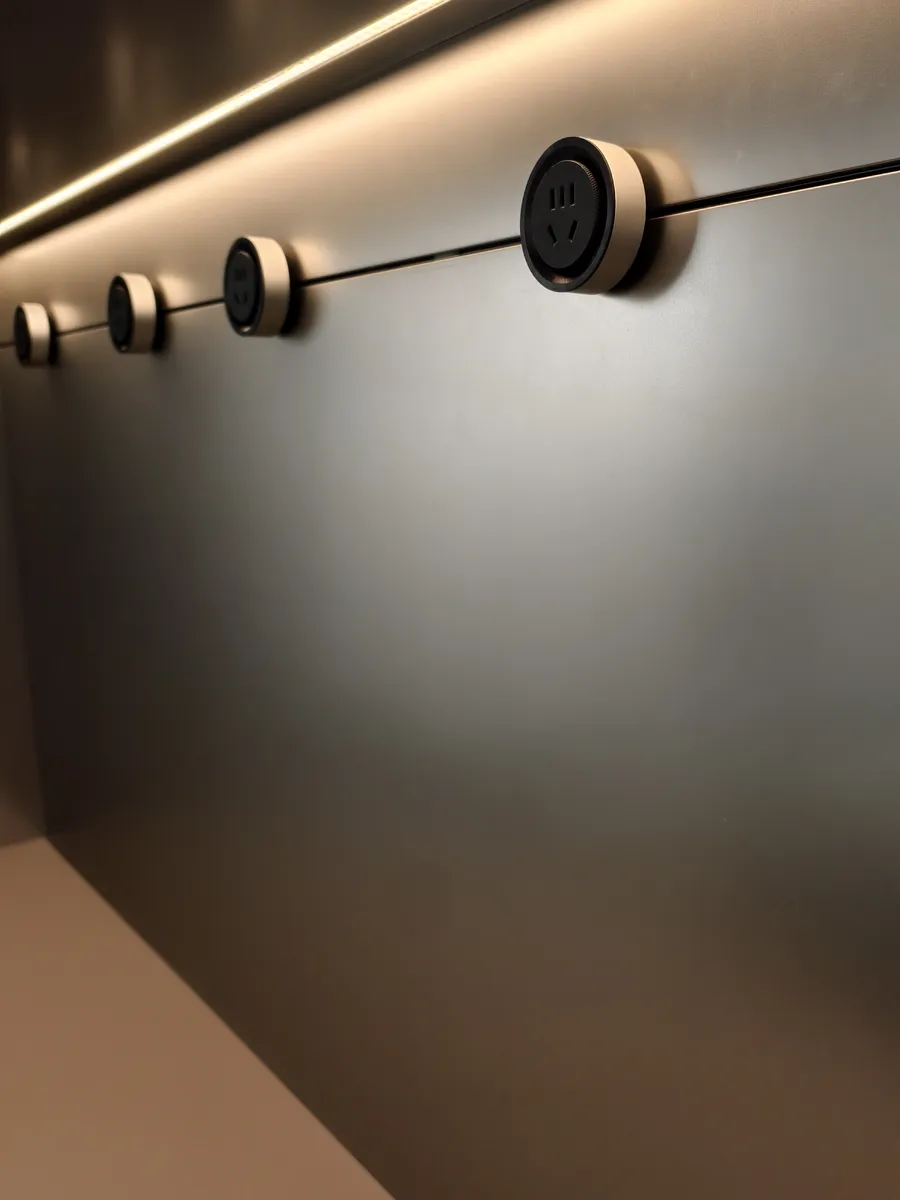
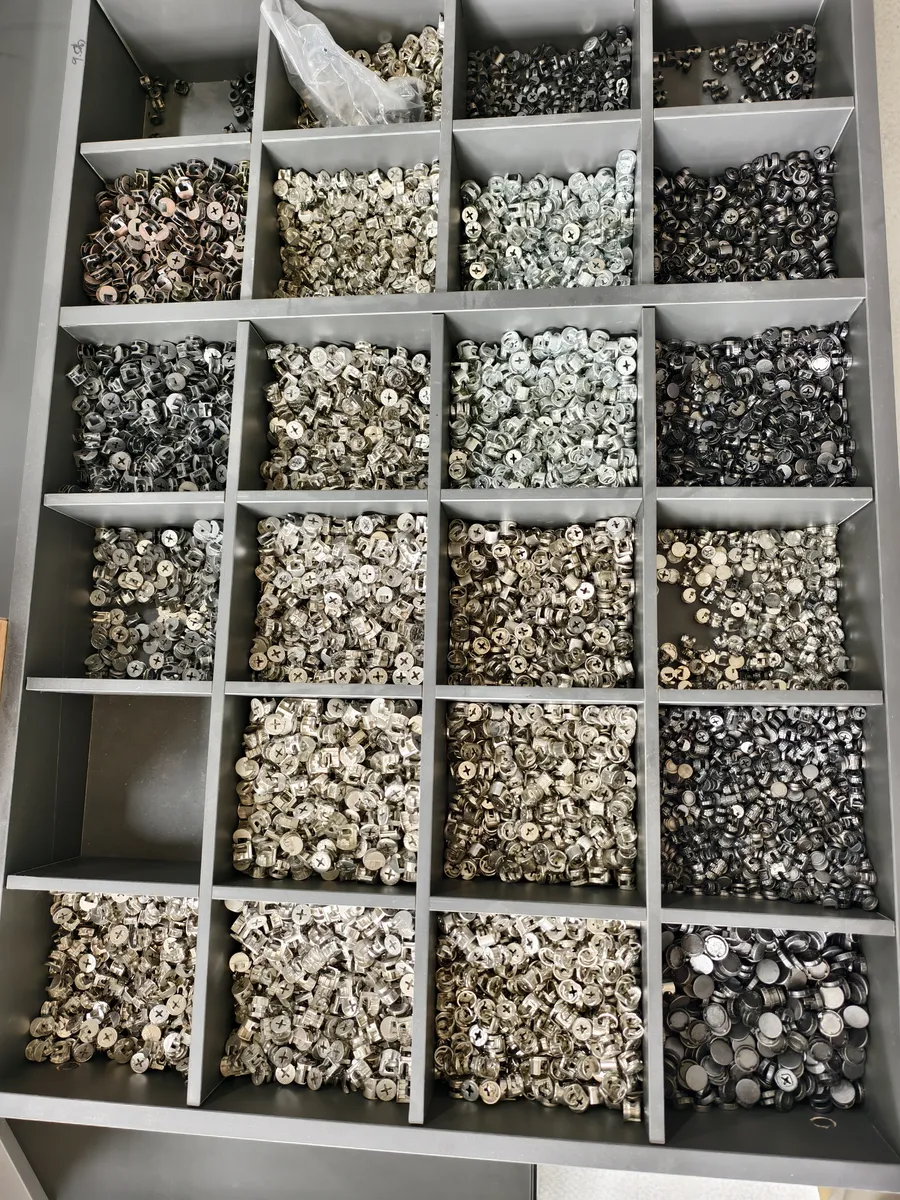
The last category is the one that separates a cabinet from a cabinet you would want again: the pop-up socket set into the carcass wall at work height, the spin hanger that gets both sides of a narrow bay without a second rod, and the fastener wall - the connectors, cams and the hinges' hardware itself - kept in order so a replacement part is a five-minute swap, not a site visit. The socket sits at the same height logic the basket towers use, where the fitting comes to the hand instead of the hand reaching for it, and the fastener wall keeps the spares in the order a site swap needs them: hinge, runner, cam, per door and per drawer. None of it shows in a render. All of it shows in year three.
They are photographed the same way as the rest of the page, in working order in the showroom, and they are included in the base hardware standard rather than quoted as an upgrade, because the alternative is a kitchen that needs them anyway.

The detail pages
Nine hardware families, nine pages.
Each family on the wall has its own page, photographed from the same showroom run: the basket wall on its own, and the eight families that make up the rest of the hardware line on their own - the finish wall, the closing system, the drawer families, the lift line, the system wall and the corner. Every page carries the same runner standard, the same warranty and the same spec-sheet discipline; the difference is the family.
- BasketsCutlery trays, dish racks, drop-down shelves and the tall towers - the page
- Handles & locksKnobs, pulls, escutcheons and the smart lock row - the page
- Hinges & fittingsSoft-close hinge sets, flap stays and the fixing boards - the page
- Spice organizersThe spice drawers, the lift-up shelf and the dispenser - the page
- Jewelry drawersFelt trays, watch compartments and the winder - the page
- Cutlery & dish drawersThe cutlery inserts, the divider racks and the dish run - the page
- Lift systemsThe wall lift, the rising shelf and the pop-up columns - the page
- Hardware systemsShelf pins, cam locks, corner connectors and the handle grids - the page
- Corner organizersThe carousel trays, the two-tier and the magic corner - the page
FAQ
Cabinet hardware, in plain answers.
What hardware standard is fitted as default?
Can you fit different hardware brands?
Do handleless doors with push-open work reliably?
Are pull-out baskets and corner units included or extra?
What happens if a hinge or runner fails after installation?
Can I see the hardware before committing?
For specifiers
Specifying hardware for a program, not a kitchen?
Volume pricing, OEM/ODM programs and a hardware sample kit - the dealer line answers in your time zone.
Every fitting, on the spec sheet before the box ships.
Send your layout - the hardware line is written into the quote, per unit, with the ratings you will get at installation.