Home / Cabinet hardware / Spice organizers
Spice organizers, photographed loaded with the load.
A spice drawer is either a drawer of jars that tip at full extension, or a system that holds the jars, the oils and the packets in the positions they live in at home. This page is the spice wall in our Foshan showroom - the wooden organizer drawer, the stainless rack with the built-in dispenser, the grey pull-out and the tall larder column - photographed loaded, mid-cycle, at the height it will sit in the kitchen.

The spice wall
The small goods, in a system that holds them.
The drawer above is the organizer in its working state: the round tins in their compartments, the wooden spoons and the utensils along the run, the stainless containers at the end, all of it on a drawer that is out at full extension on the stone floor of the showroom. The point of the photo is the load - a spice system is judged by what happens to the jars when the drawer reaches the end of its travel, and this one is photographed at exactly that moment, with nothing leaning and nothing shifted.
- RunnersFull-extension, 35-45 kg per pair, soft-close
- TraysWooden organizers, stainless inserts and removable steel baskets
- Widths450 / 600 mm drawers; the larder column follows the carcass
- DispenserBuilt-in tray cut to the drawer - itemised
- Board18 mm E0 plywood, ≤0.05 mg/m³ (GB/T 39600, report SQ2405393) - certificates
- MOQMixed orders from 1,500 sq ft - no minimum at the sample stage
- Lead10-14 days factory; DDP 18-22 US West, 32-40 US East, 15-20 Sydney
- Warranty5-year hardware warranty, aligned with the fitting manufacturer’s
The wall carries the full family around that drawer: the wide wooden cutlery-and-spice run, the stainless rack with the built-in dispenser tray, the grey pull-out with the removable baskets, and the tall larder column where the rotating tray takes the bulk goods up to the top of the run. Every unit rides the same 35 to 45 kg per pair runner standard as the drawers, the trays are cut to the width they ship in, and each is itemised on the spec sheet with its own rating - the reason the spice line quotes as a set of lines rather than a surcharge.
The drawer family
Wood organizers, stainless inserts, one runner standard.
The wide run on the left is the wooden organizer at its fullest: the round tins in their compartments, the utensils along the middle, the stainless canisters at the end, the whole drawer out on the terrazzo floor with nothing tipped. The organizer is the insert the kitchen drawer carries - the compartments cut to the jar, the run matched to the drawer width - and it is photographed loaded because a spice drawer empty looks the same as any drawer, and loaded is where the system either works or does not.
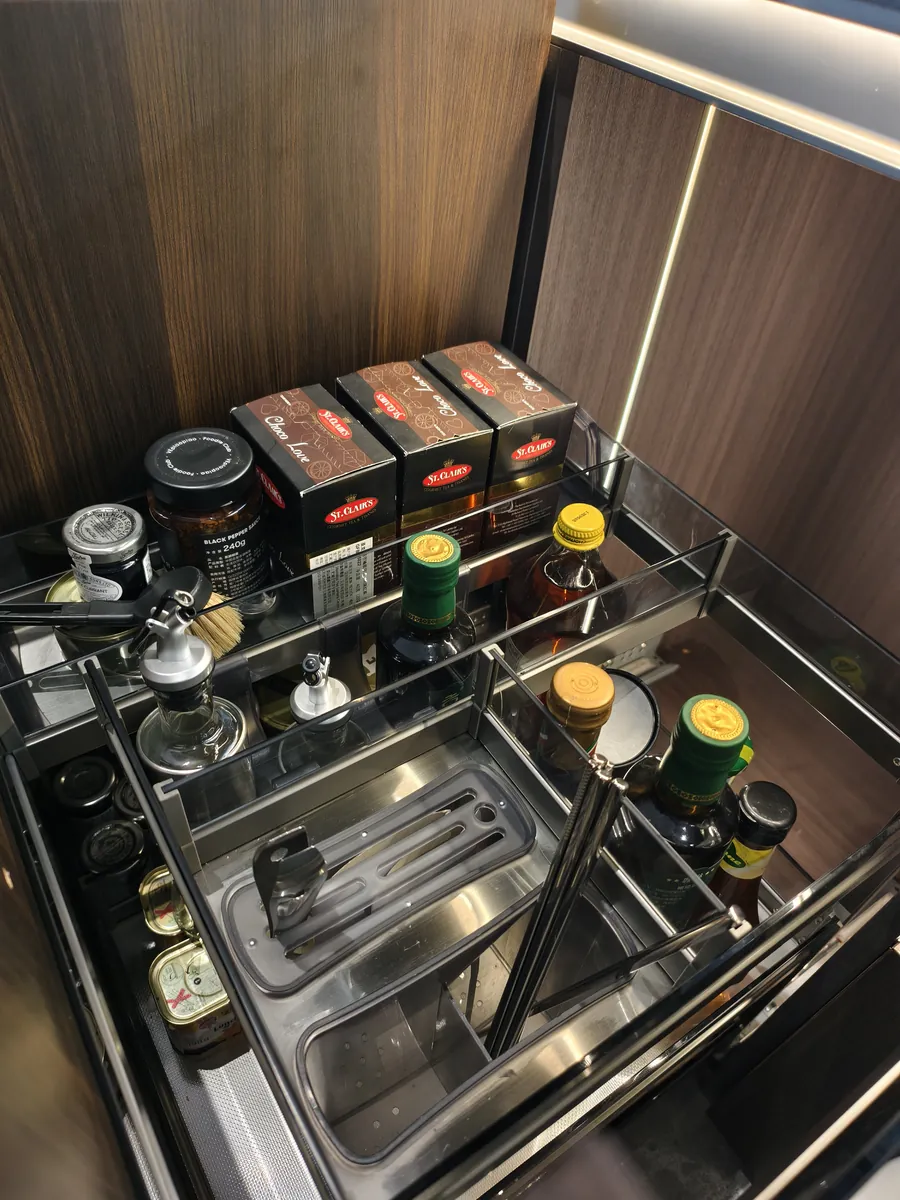
The stainless unit on the right is the other material of the same job: the rack insert with the tea cartons, the sauce bottles and the built-in dispenser tray, set into the wood cabinet interior at the angle the kitchen uses it. The wood organizer and the stainless insert ride the same runner standard, both are cut to the width they ship in, and both are itemised on the spec sheet as their own lines. The dividers reposition within the same insert, so a different jar mix is a rearrangement, not a replacement - which is the difference between a system and a tray.


The larder column
The tall unit that takes the bulk goods up.
The column above is the tall version of the spice line, photographed the way it will be used: a hand in, at working height, the stainless interior running the full height of the box. The larder pull-out is where the bulk goods live - the oil bottles, the packets, the rotating tray that brings the back row forward without the reaching - and the photo is the test state for the system, because the load that has to work is the load the family actually stores, at the height the kitchen actually gives.
The column rides the same full-extension runner standard as the drawer, sized to the carcass rather than to a catalogue height, and the rotating tray inside is itemised with its own rating on the spec sheet. The stainless interior matches the rack insert from the section above, so the wall reads as one family - the drawer at the bottom, the column above it, the same runners and the same warranty. When it goes on a spec sheet, the larder column is a line with its height, its tray set and its rating, and the box it ships in is drawn to the kitchen it will stand in.
The widths & the tray cut
The table the spice line is drawn on.
The table is the standard the spice wall is drawn from - the drawer widths, the tray cut and the larder column - and anything outside it is detailed to the kitchen, the way the kitchen sizes guide does it. The dividers reposition within the tray, so the table holds the family: a different jar mix changes the layout, not the cut.
| Element | Standard | Range |
|---|---|---|
| Organizer drawer | 450 / 600 mm insert, wooden organizer | Dividers reposition within the tray |
| Stainless rack | 450 / 600 mm, the dispenser built in | The dispenser is itemised with the tray |
| Grey pull-out | Removable baskets, cut to the width | Bottles, sauces and the jar line |
| Larder column | Follows the carcass, 3-inch steps | The rotating tray rated per unit |
The runner standard under every element is the same 35 to 45 kg per pair, and the rating is written per unit on the spec sheet the way the table writes the width - the organizer, the rack, the pull-out and the column each carry their own line, and the loaded state on this page is the state the rating was demonstrated in. The dispenser is the element that keeps its own reference, because it is a cut into the drawer rather than an add-on, and the tray it sits in is the line it is priced with.
FAQ
Spice organizers, in plain answers.
Are spice organizers included in the base cabinet price?
What sizes do the spice drawers come in?
Can the spice rack be stainless instead of wood?
How does the tall larder pull-out carry the load?
What happens if the tray dividers or runners wear?
Can I see the spice wall before I spec it?
For specifiers
Specifying a spice program, not a kitchen?
Volume pricing, OEM/ODM tray sets and a hardware sample kit - the dealer line answers in your time zone.
Every tray, rated before the drawer closes.
Send the drawer widths and the tray set - the spice line is written into the quote per unit, with the runner rating it ships under.