
Home / Importing & compliance / Nigeria
Market · Nigeria
Import kitchen cabinets to Nigeria: Form M first, then the 20% duty.
Nigeria is not a customs problem with a currency attached. It is a currency file that customs then checks. The Form M has to be registered before the goods leave China, the 2026 FX Manual caps advance payment at 30% of FOB value, and the PAAR has to be issued before the vessel arrives. Get those three in the wrong order and the container sits at Apapa while storage charges run.
Where it actually stops
The three gates that stop a container, and none of them is the duty.
Gate 1 · before shipment
Form M registered
An electronic import declaration opened through your Authorised Dealer bank, registered by Nigeria Customs before it is valid. It has to exist before the goods leave China, and the registration is what later ties the shipping documents and the PAAR together.
Gate 2 · before arrival
PAAR issued
The Pre-Arrival Assessment Report is Customs' own duty assessment, produced on NICIS II from the declaration your agent files. No PAAR, no release - regardless of what else is in order.
Gate 3 · before release
Conformity evidence
Where the product is regulated, SONCAP is a clearance precondition rather than a form to produce afterwards. It is arranged against the goods, not against the invoice, so it starts before loading.
The order matters more than the paperwork. The sequence that works is: supplier quote, compliance certificates, Form M, shipment, PAAR, declaration, duty, release. The sequence that fails is: ship first, then ask the clearing agent what was needed.
The 30% ceiling
Your bank may not release a 40% deposit, and that is a conversation for week one.
The 2026 fourth edition of the Central Bank's Foreign Exchange Manual raised the permissible advance payment on physical imports from 15% to 30% of FOB value. A 30% deposit and a 70% balance fits inside the formal bank-payment framework without a special conversation. A 40% deposit does not.
That matters here for a plain reason: we ask for 40% to lock a production slot, and the slot is confirmed in writing before the deposit is taken. On a Nigerian entry the question is not whether 40% is reasonable. It is which route carries the extra ten points, and that route has to be settled with your bank before the Form M is opened rather than after the proforma has been signed.
Three ways importers usually resolve it, none of which we can arrange for you: paying the balance above 30% from a domiciliary account held outside the Form M remittance, splitting the order into two proformas so each sits under the ceiling, or negotiating a 30% deposit against a later milestone payment tied to a pre-shipment inspection. The right answer depends on how your bank reads the transaction, and it is worth one phone call before the order rather than two weeks after it.
| Point | What the 2026 rule says |
|---|---|
| Form M threshold | Required for commercial imports above USD 1,000 |
| Validity | 180 days, extendable; machinery runs to 365 |
| Advance payment ceiling | 30% of FOB value, up from 15% |
| Opening route | CBN Trade Portal, through an Authorised Dealer bank, with a TIN |
| Retroactive filing | Not accepted - Form M precedes shipment |
If your payment structure is not settled yet, the mechanics are on what a deposit actually buys, and the bank-side questions are best put to your Authorised Dealer rather than to a supplier.
The levy stack
Four charges on one entry, and only one of them is called duty.
| Charge | Rate | Base | Note |
|---|---|---|---|
| Import duty | 20% on commercial furniture | CIF value | ECOWAS Common External Tariff band for finished goods; the band is set by HS code, and 9401 and 9403 both sit in the 20% tier |
| VAT on import | 7.5% | CIF plus duty | Collected by the Nigeria Revenue Service since 1 January 2026 rather than by Customs |
| CISS levy | 1% | FOB value | Comprehensive Import Supervision Scheme, paid to the Shippers' Council |
| ETLS levy | 0.5% | CIF value | ECOWAS Trade Liberalisation Scheme levy |
Two things catch buyers out. There is no de minimis threshold, so duty can apply at any value, and that includes sample shipments. And the exchange rate used to convert the entry is the CBN-notified rate on the assessment date, not the rate on the day the order was placed - which means a naira move between order and arrival changes the landed cost without anyone touching the price.
Conformity
SONCAP is arranged against the goods, not against the invoice.
Where a product falls under the Standards Organisation of Nigeria's regulated list, the conformity assessment has to be completed on the shipment before it can clear. On cabinets that means a Product Certificate covering the product and the factory, and a Shipment Certificate issued per consignment against that product certificate.
The practical consequence for a kitchen or a resort programme is that the paperwork runs alongside production, not after it. A shipment that reaches Apapa without the certificate is not a shipment with an incomplete file - it is a shipment that cannot be released, and the clock on port storage starts anyway.
Two other documents sit in the same window. The Combined Certificate of Value and Origin verifies value and origin, and the commercial invoice has to match the Form M exactly on both the value and the HS code. Since 2026 the CBN cross-checks Form M data against declarations in real time, and it compares invoice prices against benchmark data - so a mismatch is flagged before the vessel arrives rather than discovered at the counter.
What we have delivered
Sixty rooms, units 201 to 551, one wooden standard.
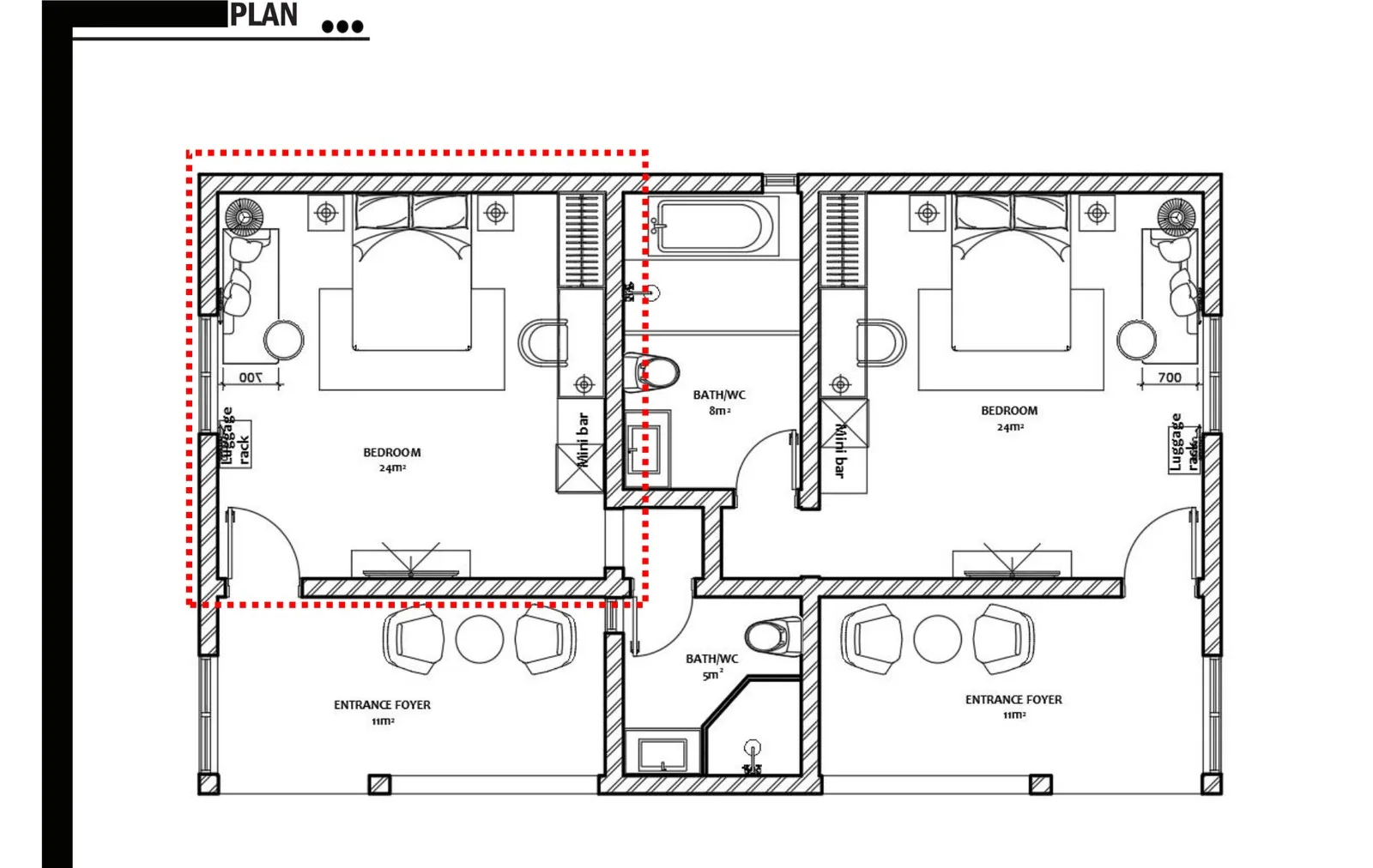
A numbered-unit resort on the Nigerian coast, delivered in 2024. Sixty guest rooms built to a single wooden material language, with the bathrooms and shower rooms shipped as matched kits so the wet areas needed no site re-measure of components.
The order was phased to the fit-out calendar rather than shipped in one lift: room groups went out as the building's floors came ready, across thirteen to seventeen weeks of ocean freight, duty-paid to Nigeria.
That phasing is the part worth copying. On a Nigerian entry the binding constraint is rarely production - it is the gap between when a container is ready and when it can be cleared. Splitting a programme into room groups means the first group absorbs the learning and the storage risk, and the later groups land against a file that is already proven.
Full record: the Nigerian resort case. The wider comparison across the continent is on the Africa page.
Before you order
What to fix on the purchase order.
- Form M before shipmentRegistered, not applied for. Retroactive filings are not accepted, and the number has to appear on the shipping documents.
- Advance payment routeSettled with your bank against the 30% ceiling before the proforma is signed, not after production has started.
- Invoice to Form M matchValue and HS code identical. A discrepancy is one of the leading causes of a hold at Lagos.
- SONCAP scopeProduct certificate in place for the product and the factory before the consignment is built.
- Clearance time in the planCargo dwell time at Nigerian seaports has been reported at around 21 days. That belongs in the installation date, not in the supplier's lead time.
- Crating marked per unitNumbered to the room, so a phased delivery can be unpacked in the order the floors are handed over.
The timber side of the crate is a separate file and it is not optional: ISPM 15 and the crate under your cabinets.
FAQ
Nigeria questions, answered.
What import duty does Nigeria charge on kitchen cabinets?
What is Form M and when does it have to be opened?
Can I pay a 40% deposit through a Nigerian bank?
Does SONCAP apply to kitchen cabinets?
How long does customs clearance take at Lagos?
Can the commercial invoice differ from the Form M value?
Send the plan, and tell us who is opening the Form M.
The quote comes back per linear foot, cabinets only, with the HS code, the crate numbering and the conformity documents your agent will ask for. Freight, duty and clearance sit outside it, and they are yours to price on the Nigerian side.