Home / Cabinet hardware / Corner organizers
Corner organizers, swung out with the load on.
The corner of the kitchen has always been the dead space - the two doors that do not open far enough, the depth a coat hanger reaches but a wrist does not. The corner line is the fix in its working states: the carousel trays swung out on their pivots, the two-tier corner at full extension, the loaded run that makes the dead space the most used storage in the room. This page is that line in our Foshan showroom.
The corner line
The dead space, turned into the working run.
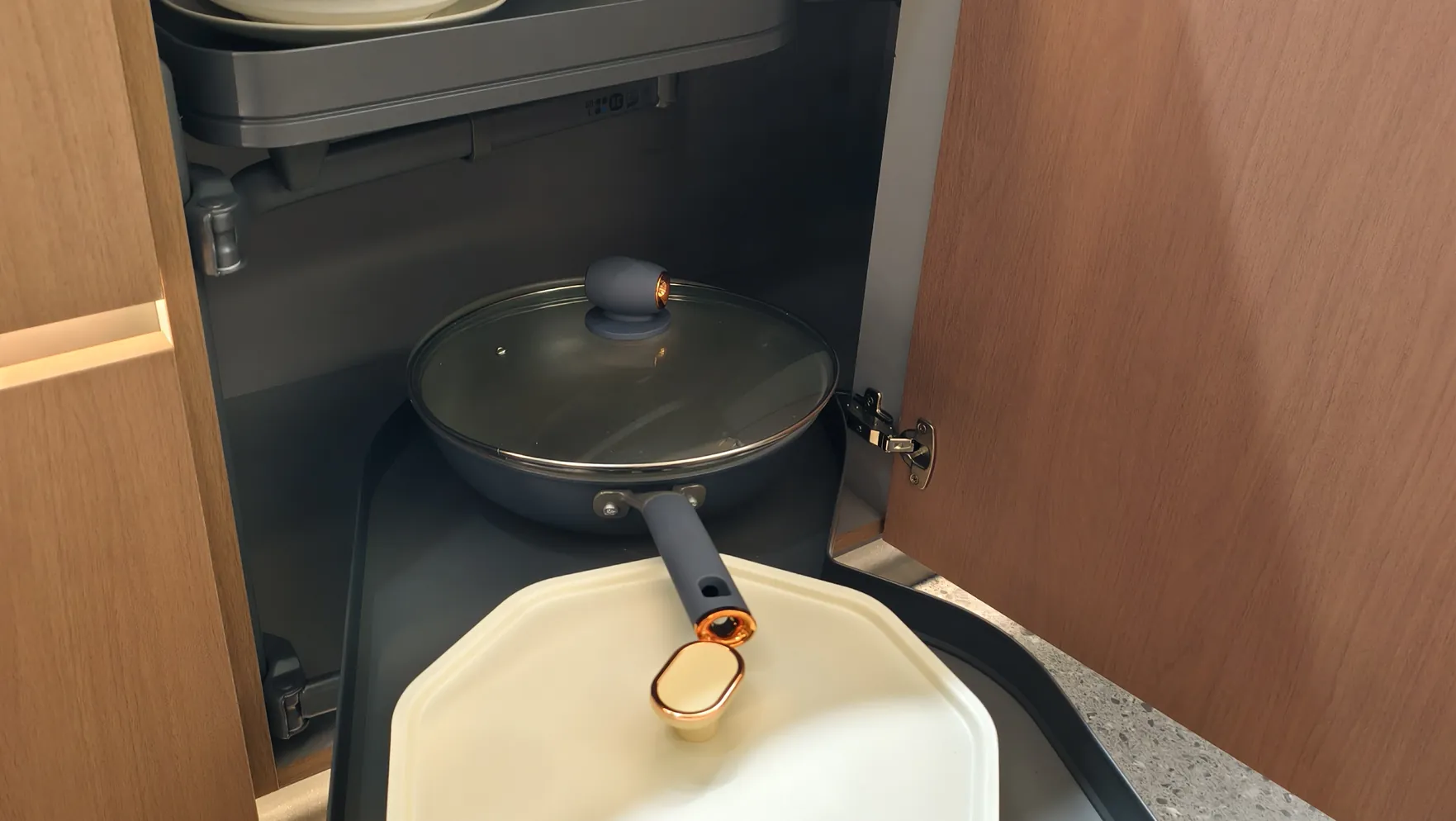
The unit above is the corner carousel in its working state: the kidney-shaped trays swung out from the base cabinet on their pivot, the two tiers running at the spacing the shelf heights give, the grey finish of the trays against the wood carcass around them. The photo is the state the corner is judged in - out, on the pivot, with the trays clear of the carcass wall - because a corner organizer is either the storage the kitchen uses or the storage it forgets, and the difference is the travel the pivot gives.
- CarouselsKidney trays on the pivot, single and two-tier
- RunnersFull-extension, 35-45 kg per pair, soft-close
- TraysPowder-coated steel, grey or dark, cut to the carcass
- Widths9 to 48 inches in 3-inch steps, to the base cabinet
- Board18 mm E0 plywood, ≤0.05 mg/m³ (GB/T 39600, report SQ2405393) - certificates
- MOQMixed orders from 1,500 sq ft - no minimum at the sample stage
- Lead10-14 days factory; DDP 18-22 US West, 32-40 US East, 15-20 Sydney
- Warranty5-year hardware warranty, aligned with the fitting manufacturer’s
The line runs around that unit into the rest of the corner family: the carousel with the jars and the pantry items loaded on the trays, the dark grey run extended from the neighbouring base, the two-tier configuration at the spacing the box allows. Every unit rides the same runner and pivot standard the baskets page carries, the trays are cut to the carcass they ship in, and each unit is itemised on the spec sheet with its own rating - the corner line quotes as a set of units, which is how the dead space stops being a surcharge and starts being a line.
The carousel, and the arm that swings it
One motion, and the corner is at the hand.
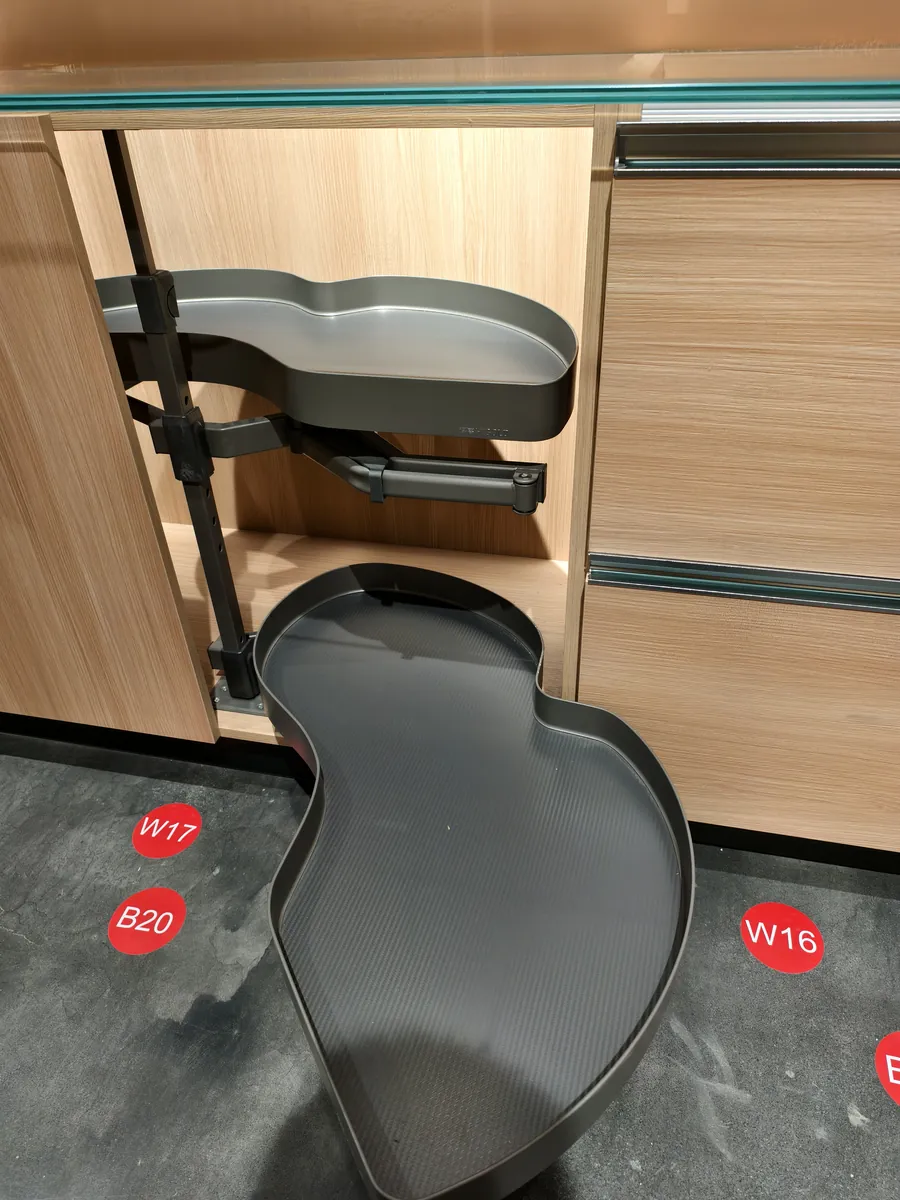
The cabinet on the left is the corner in its fixed state made to work: the two grey trays swung out on the carousel arm, the light wood carcass around them, the trays clear of the wall the doors could not reach. The arm is the element the corner runs on - the pivot that takes the trays from the dead angle to the working one in a single motion, and the photo is the arm in the motion, because the travel is the product and the trays are the load it carries.
The two-tier unit on the right is the same arm with the spacing worked in: the kidney trays at the heights the box allows, the pivot and the shelf spacing visible in the frame, the grey finish reading against the wood carcass. The tier spacing follows the carcass depth rather than a fixed gap, the trays are cut to the width they ship in, and the pivot is rated with the unit it serves on the spec sheet. Both units are cycled at the factory before the box is wrapped, and both ride the same runner standard as the baskets wall - the corner is the family's dead-space member, not a separate system.


The loaded corner
The pantry in the space the kitchen forgot.
The unit above is the carousel in the loaded state: the glass jars and the tins on the trays, the pantry items in the run, the hand coming in at the upper edge for the jar at the back. The photo is the test state for the corner line, because the load that has to work is the load the kitchen actually stores in the dead space - the oils, the jars, the items that a fixed shelf would push to the back and a door would not bring forward. The carousel brings the back row to the hand in the same motion it brings the front row.
The trays carry the load at the pivot's rating, which is written on the spec sheet with the unit it serves, and the powder-coated steel of the trays is the same material the baskets wall runs. The corner organizer is the answer for the base that would otherwise store the pantry where the reach does not go, and it is itemised on the spec sheet with its rating - the loaded state in the photo is the state the rating was demonstrated in, at the factory, before the box was wrapped. The dead space becomes the line the kitchen uses daily, and the spec sheet shows it as the unit it is.
The two tiers, and the standard under them
The corner, itemised like the rest of the wall.
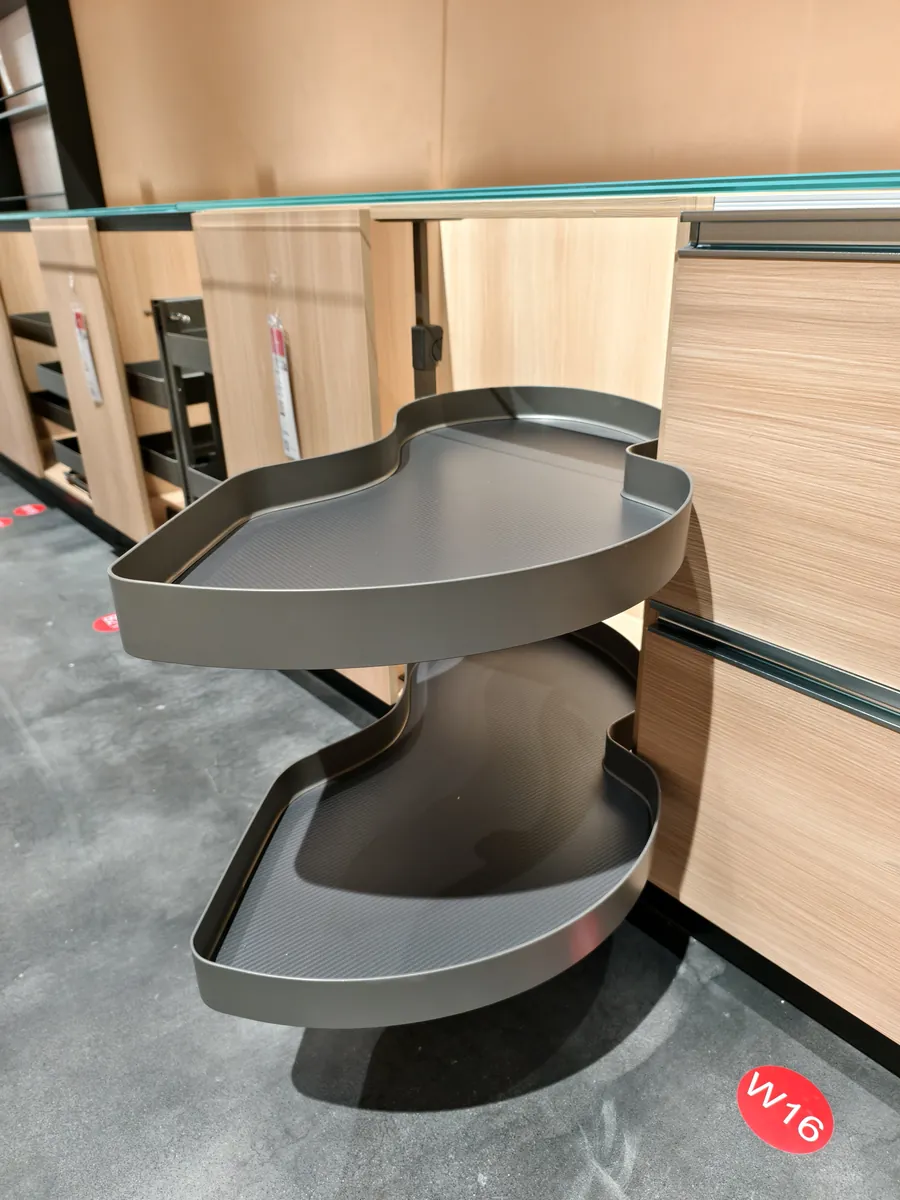
The run on the left is the corner line in its dark grey finish, extended from the base unit with the neighbouring cabinets of the showroom running behind it. The finish of the trays is the choice the program makes - the grey or the dark against the carcass - and the photo is the run in the state it ships, extended, at the travel the pivot gives, with the finish reading against the wood the way it will in the kitchen it goes to.
Under the finish is the standard every unit on the line runs: the pivot rated with the tray it serves, the runner at 35 to 45 kg per pair, the tray cut to the carcass, the cycle at the factory before the box is wrapped. Each unit is itemised on the spec sheet with its reference and its rating, the 5-year hardware warranty covers the pivot, the trays and the runner as the lines they are, and the baskets page carries the wider family on the same standard. The corner is the family's answer for the dead space, and it ships as the line the spec sheet shows it as.
FAQ
Corner organizers, in plain answers.
What is the difference between the corner carousel and the corner pull-out?
What sizes do the corner organizers come in?
How much can the corner carousel carry?
Do the corner units come with soft-close?
What happens if the pivot or the trays wear?
Can I see the corner line before I spec it?
For specifiers
Specifying a corner program, not a kitchen?
Volume pricing, OEM/ODM tray sets and a hardware sample kit - the dealer line answers in your time zone.
Every corner, itemised with its pivot rating.
Send the base widths and the tray set - the corner line is written into the quote per unit, with the rating it ships under.