What the border actually charges, as percentages.
Two charges, calculated on two different bases, and only one of them is a real cost to a VAT-registered business.
Duty is 2 percent of the customs value - the value of the goods as declared, which for these terms is the price paid plus the freight and insurance to the UK border. It is small enough that buyers stop modelling it, and that is usually fine: 2 percent does not change a program decision.
Import VAT is 20 percent, and its base is the customs value plus the duty plus chargeable incidental costs, including transport to the first UK destination where that is known at import. It is not calculated on the factory invoice alone. That is where hand-built spreadsheets go wrong, and it is the number HMRC will reconcile against the entry.
A VAT-registered importer normally recovers the VAT, and can use postponed VAT accounting so it never leaves the bank account. That makes the VAT a cash-flow question rather than a cost question - but only if it was calculated on the right base. A private buyer or a business below the registration threshold carries it, which is why the same container is a different proposition depending on whose name is on the entry.
There is a low-value consignment threshold where duty is waived while VAT still applies from the first penny, but a cabinet program never lands under it. It matters only for sample doors and small spare parts, which is exactly when nobody thinks to check.
Great Britain and Northern Ireland are two different files.
Great Britain - England, Scotland and Wales - runs the regime described on this page. Northern Ireland has its own arrangements, and the UK government's own guidance separates the two. If a program has units going to both, treat them as two imports and two files, because that is what they are.
It sounds like a technicality until a container is booked to Belfast on a Glasgow file. Ask which address the goods are first delivered to, not which country the project is in.
The timber file is a UKTR file, not an EUDR one.
The UK timber regime covers composite furniture, so a plywood carcass is in scope, not just solid timber. If you are the first to place the cabinets on the GB market, the obligation is due diligence: species, quantity, supplier and country of harvest, a risk assessment on illegal sourcing, and evidence that any identified risk was reduced to negligible before the goods were placed.
Three practical points from our side of the table. First, the manufacturing address says nothing about where the tree was cut, so the harvest country is a separate question. Second, ask for the timber information per component - carcass, doors, back panels, drawer bottoms - because a composite panel carries more than one species and a board brand is not a species. Third, keep the risk assessment with the order file rather than in an email thread.
The EU regulation is a separate regime with its own timetable and its own electronic statement, and it does not apply to goods placed on the GB market. The two are often discussed as one subject; they are not one file. The species and harvest-country breakdown behind both, and the packaging side of the same shipment, are covered separately.
What clears a UK entry, in order.
- A GB EORI number in the importer's name. Without it nothing can be declared, and a non-UK seller usually appoints a UK agent or buys a delivered-duty-paid service instead.
- The commodity code, confirmed against the drawings - not against the previous shipment. Parts shipped separately from the cabinets can take a different code from the cabinets themselves.
- A commercial invoice and packing list that agree with each other and with the entry, per carton and per cabinet code.
- The transport document, and a statement on origin if you are claiming a preferential rate under a UK trade agreement.
- The timber due-diligence file, assembled during procurement rather than at the broker's desk.
HMRC collects through the Customs Declaration Service. Unlike the Canadian entry there is no safeguard code to quote here - the UK file is shorter, but the two items people forget are the same everywhere: the origin statement when they wanted a preference, and the timber information nobody collected in time.
One standard worth naming: BS EN 14749.
It is the standard for domestic and kitchen storage furniture, and it covers requirements and test methods. The clause worth reading twice is the scope: walls and wall fixings are excluded.
That has a practical consequence on refurbishment work. A cabinet can pass the standard and still fail in a room, because the failure is in the substrate or the fixing, and neither is in the test. So the wall survey belongs to the order, alongside the cabinet schedule - not to the fitter's first morning. We ask for the wall construction at quotation stage on UK refurbishments for this reason: it changes the fixing pack, and sometimes it changes the design.
Programs a UK order usually runs on.
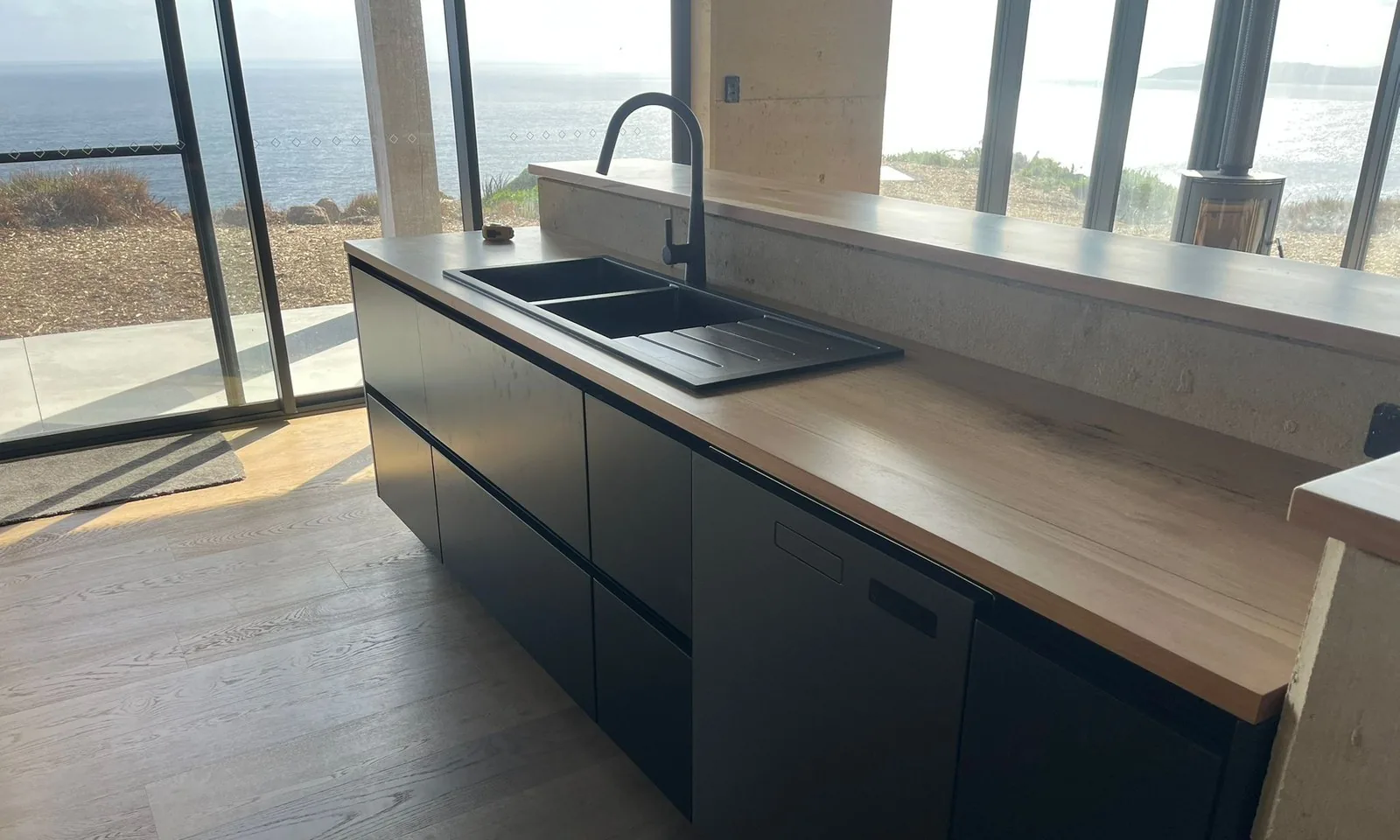
Two UK programs are documented in the project pages: one whole-house order that runs kitchen through to dressing room on a single concept and two tones, and one whole-home cabinet program built to one standard across every room. The German apartment block - thirteen units on one order - is the same discipline applied to a repeating room type.
What those three have in common is not the finish. It is that the schedule was fixed before production, so the border file could be built from a document rather than reconstructed from memory. The frozen spec sheet is the tool we use for that, and the multi-unit spec method is how it scales across rooms.
The spec does not change at the border.
The same 18 mm E0-grade plywood carcass, the same 2 mm PVB hot-melt edge banding on every cut edge, the same soft-close hinges rated to 50,000 cycles, goes to a UK address as to a US or Australian one. What changes is the paperwork in front of it and the electrical and appliance context on site.
Which is the argument for fixing the material schedule once and reusing it market by market. A US order and a UK order that differ only in the entry file should not differ in the board.