Home / Cabinet hardware / Lift & pop-up systems
Lift systems and pop-up sockets, in working order.
The lift line is the hardware that brings the cabinet to the hand instead of the hand to the cabinet: the wall lift that takes the top row down, the lift-down unit that opens the high bay, the pop-up columns that bring the power to the worktop when it is needed and clear of it when it is not. This page is that line in our Foshan showroom, photographed mid-travel.

The lift line
The cabinet that comes down, and the power that rises.
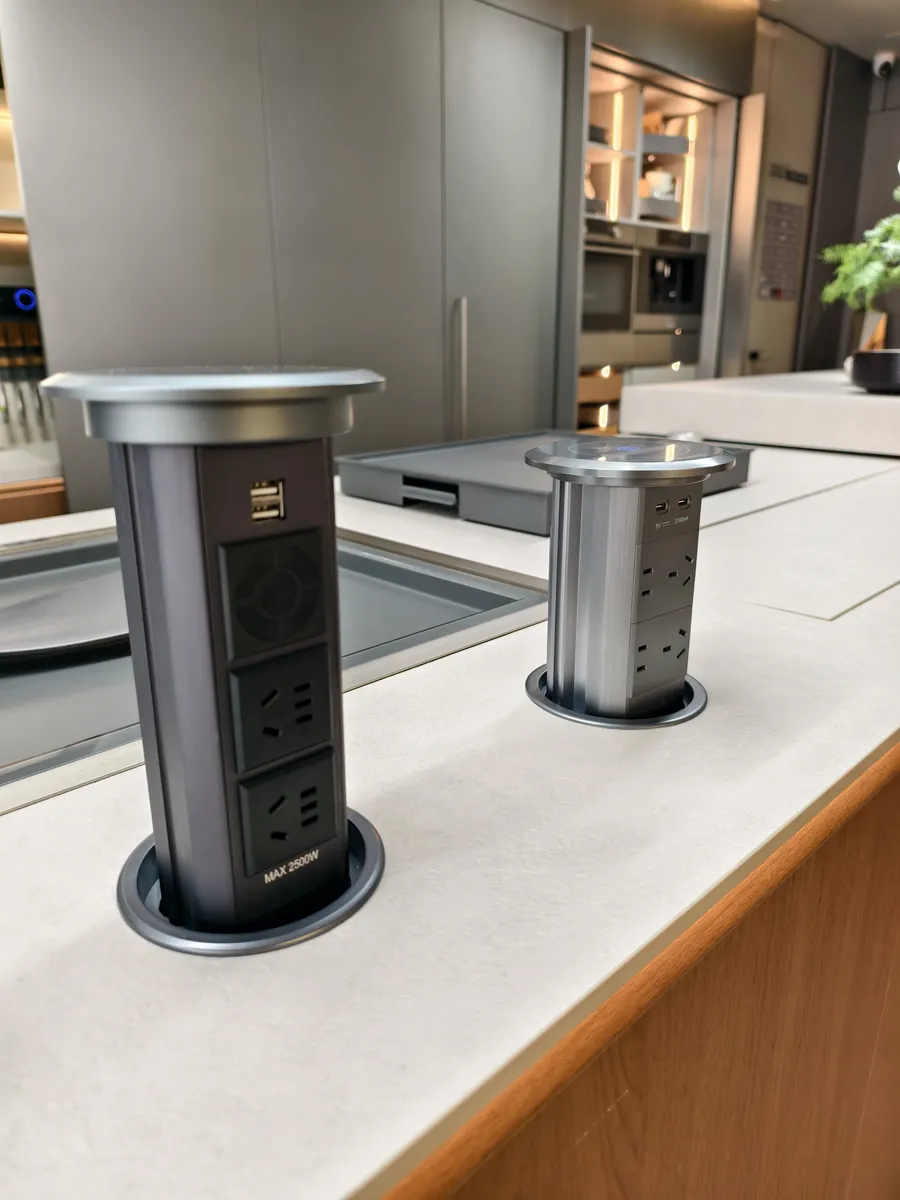
The columns above are the pop-up socket line in its working state: the two units raised from the stone worktop, the USB and the multi-pin outlets facing forward, the grey and the brushed metal housings at working height, the cabinetry of the kitchen running behind them. The columns come up on the push, they hold at the height the small appliance needs, and they go back down to leave the worktop clear - which is the whole job of the line, photographed at the moment the job is done.
- MechanismsWall lift, lift-down arm, rising shelf - sized to the load
- ColumnsPop-up socket, USB and multi-pin; charging pad version
- SizingMechanism and column rated to the panel / worktop they serve
- StandardItemised per unit on the spec sheet
- Board18 mm E0 plywood, ≤0.05 mg/m³ (GB/T 39600, report SQ2405393) - certificates
- MOQMixed orders from 1,500 sq ft - no minimum at the sample stage
- Lead10-14 days factory; DDP 18-22 US West, 32-40 US East, 15-20 Sydney
- Warranty5-year hardware warranty, aligned with the fitting manufacturer’s
The lift line runs around those columns into the cabinet side: the wall lift that brings the top row down to working height, the lift-down unit that opens the high bay on its arm, and the rising shelf that takes the top shelf out of the reach problem entirely. Every mechanism on the line is sized to the load it carries rather than to a catalogue length, each is rated and itemised on the spec sheet with its own reference, and the 5-year hardware warranty covers the mechanism, the mount and the column as the lines they are. The wall is photographed mid-travel, because a lift system is judged in motion, not at rest.
The wall lift
The top row, brought to working height.
The mechanism on the left is the wall lift in its working state: the black frame, the cable, the timber baffles and the glass shelf edge at the top of the run, the drawers working below it. The lift is the mechanism that takes the top row of the kitchen down to working height and holds it there, and it is photographed at the mechanism - the frame, the cable, the shelf edge - because that is where the system is either sized right or not, and the rest of the cabinet is the load it carries. The columns on the right are the worktop half of the same line, raised from the stone counter at the height the small appliance needs them - the two photographs are the two ends of the lift family, the cabinet that comes down and the power that rises.
The lift is sized to the panel weight rather than to a catalogue length, which is the discipline that keeps the top row holding at the working height at year five the way it holds on the showroom wall. The rating for the mechanism and the shelf is written on the spec sheet per unit, the glass shelf version keeps the glassware sealed when the lift is down, and the whole assembly is cycled at the factory before the box is wrapped. The mechanism, the shelf and the mount are itemised as the lines they are, which is how the wall lift quotes as a decision on the spec sheet rather than a surcharge on the cabinet.


The pop-up columns
Power at the worktop, clear of the worktop.
The units above are the pop-up socket line in its retractable form: the two columns standing above the pale worktop, the round charging pad on the lid of one, the USB and the socket outlets on the bodies of both. The columns are the answer for the small appliances that live on the worktop - the kettle, the grinder, the toaster - and the job they do is the one the photo shows: the power at the height the appliance needs it, and the worktop clear of it the rest of the time, with the charging pad taking the phone off the counter as well.
Each column is a cut before the worktop closes - the opening, the wiring, the housing - which is the discipline the sink bay runs on the countertop line, and the reason the column is itemised on the spec sheet with the worktop it serves rather than added to the program after the drawing is done. The outlet count and the USB set are written on the spec sheet per column, the housing is the grey or the brushed metal the run carries, and the column is cycled at the factory in the state it ships in. The worktop stays one plane with the columns down, and the kitchen reads as a run instead of a power strip.

The lift-down, and the line as one system
Every mechanism rated to the load it carries.
The unit on the left is the lift-down in its open state: the metal arm carrying the panel, the glass panels sealed behind it, the white interior working at the height the arm brings it to. The lift-down is the mechanism for the high bay that a hinge would reach but not hold - the panel opens on the arm, the interior comes to the hand, and the arm is sized to the panel weight the way the wall lift mechanism is sized to its shelf. The glass version keeps the bay sealed when it closes, which is the configuration the display runs use.
The line on this page is one system with four mechanisms - the wall lift, the lift-down, the rising shelf and the pop-up column - and the discipline that holds it together is the same one the hinge and the runner lines run: the mechanism is sized to the load, the rating is written per unit on the spec sheet, the assembly is cycled at the factory, and the 5-year warranty covers the mechanism, the mount and the column as the lines they are. When a program needs the line, it is drawn into the cabinet with the panel it serves, and the spec sheet carries each mechanism with its reference - which is how the lift line ships as a system rather than a set of extras.
FAQ
Lift systems, in plain answers.
Is the wall lift a replacement for the drop-down shelf?
How does the lift-down cabinet work?
Do the pop-up sockets work with our worktop?
Is there a wireless charging version of the column?
What warranty covers the lift mechanisms?
Can I see the lift line before I spec it?
For specifiers
Specifying a lift program, not a kitchen?
Volume pricing, OEM/ODM mechanism sets and a hardware sample kit - the dealer line answers in your time zone.
Every mechanism, rated to the load it carries.
Send the panel weights and the worktop drawing - the lift line is written into the quote per unit, with the rating it ships under.