What has to be paid before the container leaves the port
Buyers usually think of the tariff as one number. In 2026 it is four, plus the logistics that move the box from the dock to the job site:
| Layer | What it is | Rate on Chinese cabinets, October 2026 |
|---|---|---|
| Entered value | The goods - FOB transaction value, the base every percentage below is applied to | - |
| Section 232 | Wood-products national-security surcharge on completed kitchen cabinets and vanities and parts | +25% (9903.76.03) |
| Section 301 | China list duty (List 3) on the cabinet subheadings, in force since May 10, 2019 and unchanged by the 2024 four-year review | +25% (9903.88.03) |
| AD / CVD | Anti-dumping and countervailing orders on wooden cabinets and vanities from China | By exporter - see below |
| Base duty | The ordinary MFN rate on the declared HTS subheading | 0% on 9403.40 / 9403.60 - broker confirms per line |
| Clearance & tail | ISF, broker, drayage, in-truck delivery | Quoted per order |
Two mechanical points that change how the arithmetic reads. First, every ad valorem percentage above is applied to the same entered value of the goods - 25% + 25% + 19.5% of the goods value, not 25%, then 25% of that. Second, there is a fourth Section 301 action you may have been quoted that does not apply here: the forced-labour duty of 12.5% on China, in force since July 24, 2026. U.S. note 52(f)(4) to Chapter 99 exempts wood products entered under headings 9903.76.01, .02 and .03 - which is the heading your cabinets are entered under. If a broker adds 12.5% to a cabinet entry, ask which heading they declared. What makes the total volatile is not the math, it is the inputs: which heading the goods enter under, which exporter's rate applies, and what the entry date lands on in the policy calendar. All three move in 2026, and all three are checkable before entry - which is the point of the order process and of the broker questions at the end of this guide.
Section 232 on kitchen cabinets and vanities: where it stands today
The current rate is 25%, and the rate that was supposed to follow it has been postponed a year. Both facts are worth knowing before anyone quotes you a landed number, because the 50% headline still circulates in trade press and in dealer groups.
The 25% layer, and what it covers
The proclamation of September 29, 2025 added heading 9903.76.03 to the tariff schedule, effective for goods entered on or after October 14, 2025: the ordinary rate on the applicable subheading, plus 25%, on completed kitchen cabinets and vanities and parts thereof, classified under 9403.40.9060, 9403.60.8093 and 9403.91.0080. Two details do most of the practical work. First, "parts" is in the text - a shipment of door panels, frames or drawer boxes is inside the heading, not outside it. Second, the annex states that antidumping, countervailing and other duties "shall continue to be imposed in addition to" the 232 rate - so the 25% is a layer on top of AD/CVD, not a substitute for it. And one classification footnote: a cabinet that is not wooden falls under a different heading (9903.76.04) with no additional 232 duty - which is part of why the stainless system reads differently on a duty line than the plywood line, all else equal.
The 50% step that was delayed
The same proclamation scheduled the cabinet rate to rise from 25% to 50% on January 1, 2026. It never did. A proclamation dated December 31, 2025 delayed the increase "for an additional year," stating that the United States "continues to engage in productive negotiations with trade partners" on wood products. As of October 2026, the rate in force is still 25%; the next scheduled step lands on January 1, 2027 unless further action is taken. Treat 25% as the planning number, and re-check the Federal Register before an entry date that sits near a scheduled step - this is the single most re-verified line in the import guides on this site, for the reason that steps get moved by proclamation, sometimes on a holiday.
The agreement-country carve-outs
The 25% applies to all origins except the agreement countries, which sit under separate headings: the United Kingdom at 10% plus the base rate (9903.76.20), and Japan and the EU members at a 15% cap inclusive of the base rate (9903.76.21 / 9903.76.22). If you are comparing a Chinese cabinet against a UK-made one on duty alone, the gap on the 232 line is 15 points before AD/CVD is even considered - and the AD/CVD orders apply to China only, so the full comparison is origin plus classification, not just "which factory is cheapest." Vietnam sits in a third position: the duty lines are lighter, but the anti-dumping orders still reach goods that were only finished there - the Vietnam comparison sets it out line by line.
AD/CVD is a different tax, with a different test
Section 232 is a policy decision with one rate for everyone. Anti-dumping and countervailing duties are trade-remedy orders with a rate for every exporter - and they are the layer that separates a workable order from a bad one.
The orders and their scope
Both orders - AD case A-570-106 and CVD case C-570-107 - have been in effect since April 21, 2020. They cover "wooden cabinets and vanities that are for permanent installation (including floor mounted, wall mounted, ceiling hung or by attachment of plumbing), and wooden components thereof." The orders have survived the first sunset review (completed July and August 2025, with the USITC finding that revocation would likely lead to continuation of injury) and the trade court's 2025 decision upholding them; Commerce has also opened circumvention inquiries aimed at parts-only shipments. The scope text, not the supplier's website, decides what is covered.
Why two quotes cannot use one duty number
The cash-deposit rate follows the exporter that produced and shipped the goods. From the final results published in 2026 (AD final, April 23; CVD final, March 13):
| Rate (cash deposit, ad valorem) | AD - A-570-106 | CVD - C-570-107 |
|---|---|---|
| KM Cabinetry Co., Ltd. | 43.92% | 11.85% |
| The Ancientree Cabinet Co., Ltd. | 7.67% | 9.33% |
| Separate-rate / review-specific average | 10.02% | 9.51% |
| China-wide (no individual rate) | 251.64% | Per company assignment |
Rates as published for entries on or after the respective publication dates; Commerce revises them in each annual administrative review. If an exporter has never been assigned its own rate - or the manufacturer has - the China-wide rate applies, and 251.64% is a 2.5× charge on the goods value before any other layer. "Same container, two factories, two numbers" is not a metaphor; it is the mechanics of the rate structure.
Parts are in scope too
Door panels, frames and drawer boxes are "wooden components thereof" - in the AD/CVD scope and in the Section 232 heading. Structuring an order as "just the parts" to sit outside the orders does not survive classification, and the circumvention inquiries exist precisely because someone tried. If a quote splits a kitchen into cabinet bodies and separate door shipments, ask the broker to confirm both entries against the scope text before you commit.
Which of the four lines you can actually argue with
Three of the four lines on that table are the same for every factory on earth, so they are not a differentiator and no supplier can price them away. The base rate is 0% on the cabinet subheadings. Section 232 is 25% for any origin outside the agreement countries. Section 301 List 3 is 25% because the goods are Chinese. If two quotes differ by more than a couple of points on those three, one of them is not quoting the same thing.
The fourth line is different in kind, and it is the only one worth an argument. The anti-dumping rate is not a property of a cabinet - it is a property of the company that produced and shipped it. That matters for how you read the number that circulates most widely on this subject: 251.64% is not a forecast for your order. It is what the order says when the exporter has never been assigned a rate of its own, which is the normal state of affairs for a factory that has never cleared a container through a US broker. The named companies in the latest final results sit between 7.67% and 43.92%, and exporters who have been through a review land near 19.5% combined. One question separates those worlds, and it costs nothing to ask: "What is my AD cash-deposit rate, in writing, for the entry date we are quoting?"
And the comparison you have probably already read
If you have compared Chinese cabinets against Vietnamese or Malaysian ones, you have probably seen the claim that those origins pay 25% where China pays 50%. On the duty lines that comparison is correct. It is also incomplete, because it compares rates without comparing the value the rates are applied to - and because it leaves out the two things a factory is actually selling. The first is the programme: a complete custom run with a booked production slot and a full set of shop drawings is not the same product as a standard box, and no duty line prices it. The second is the figure that actually lands, which is total cost per linear foot with the factory price, the duty lines, the freight and the clearance already inside it. Two quotes that differ only in duty rate are usually two quotes for different cabinets.
What we put on our side of that ledger is written down rather than promised: 10-14 days of production for kitchens and vanities and 12-16 for closets, photo checkpoints at three stages, and a duty-paid price fixed to your dock before the container sails. What we will not do is quote you a rate we have not verified - so the AD and CVD lines for your entry go in writing, before the order, not after it.
Two US programs were quoted under exactly these lines: a marble and metallic lacquer residence and a dark wood and marble villa. On both, the duty lines sit on the quote as separate rows rather than folded into one number - which is the only way to tell a duty change from a price change six months later.
Section 301: the layer that moved under your feet
The 301 layer is the one most buyers have not re-verified since 2025, because the legal basis for US - China tariffs changed three times in eight months. The short version of the current state, as of October 2026:
- The layer that applies to your cabinets is the China list duty - List 3, heading 9903.88.03, at 25%. It has been at 25% since May 10, 2019, and the four-year review that completed in 2024 raised strategic categories - EVs, semiconductors, solar cells, steel and aluminium - while leaving furniture and cabinetry untouched. This is the layer most broker quotes bury in a line item.
- The forced-labour action of July 24, 2026 does not apply to you. The USTR imposed 12.5% on Chinese goods (heading 9903.05.31), but U.S. note 52(f)(4) to Chapter 99 exempts wood products entered under 9903.76.01, .02 and .03 - the Section 232 wood headings, which is where cabinets go. The exemption is written by tariff heading, not by origin, so it applies whatever factory the goods come from.
- February 20, 2026 - the Supreme Court invalidated the IEEPA tariffs (the emergency-authority duties that carried the "reciprocal" and fentanyl lines), and CBP began certifying refunds - roughly $107 billion certified by late August 2026 on about $166 billion collected. The Section 122 surcharge that replaced them ran its 150-day course and expired July 24, 2026.
- A further Section 301 layer on Chinese goods, reported at 7.5% (the "excess capacity" investigation) was held back pending the September 2026 Washington summit; as of this writing it has not been imposed. The truce suspensions from October 2025 lapse November 10, 2026, and Chinese officials have described 20% as the aggregate Section 301 ceiling consistent with that truce.
The practical consequence: the 301 line on a cabinet entry is 25% under List 3, it has been there for six years, and it is the same for every Chinese factory - so it is not where a quote should be won or lost. Where it can be lost is the anti-dumping line, which is the one that follows the exporter. Under DDP both legs are our line to carry: the number you approve is fixed before the container sails, and if a rate moves mid-transit, the delta is not yours.
Duty-paid (DDP) vs FOB: who carries which risk
The four layers above are the same under both terms. What changes is who owns them between the factory gate and your dock:
| FOB / CIF (you clear) | DDP (we clear) | |
|---|---|---|
| Importer of record | You | Supplier |
| Entry, broker, ISF | You engage and pay | Included |
| Rate research (232 / 301 / AD / CVD) | You or your broker, per entry | Included - confirmed before entry |
| Storage fees if entry is unresolved | Yours, from day one | Ours |
| AD assessment at liquidation | Yours if the rate was under-deposited | Ours |
| Price certainty | Freight moves; duties move at the port | Fixed to the dock before the container ships |
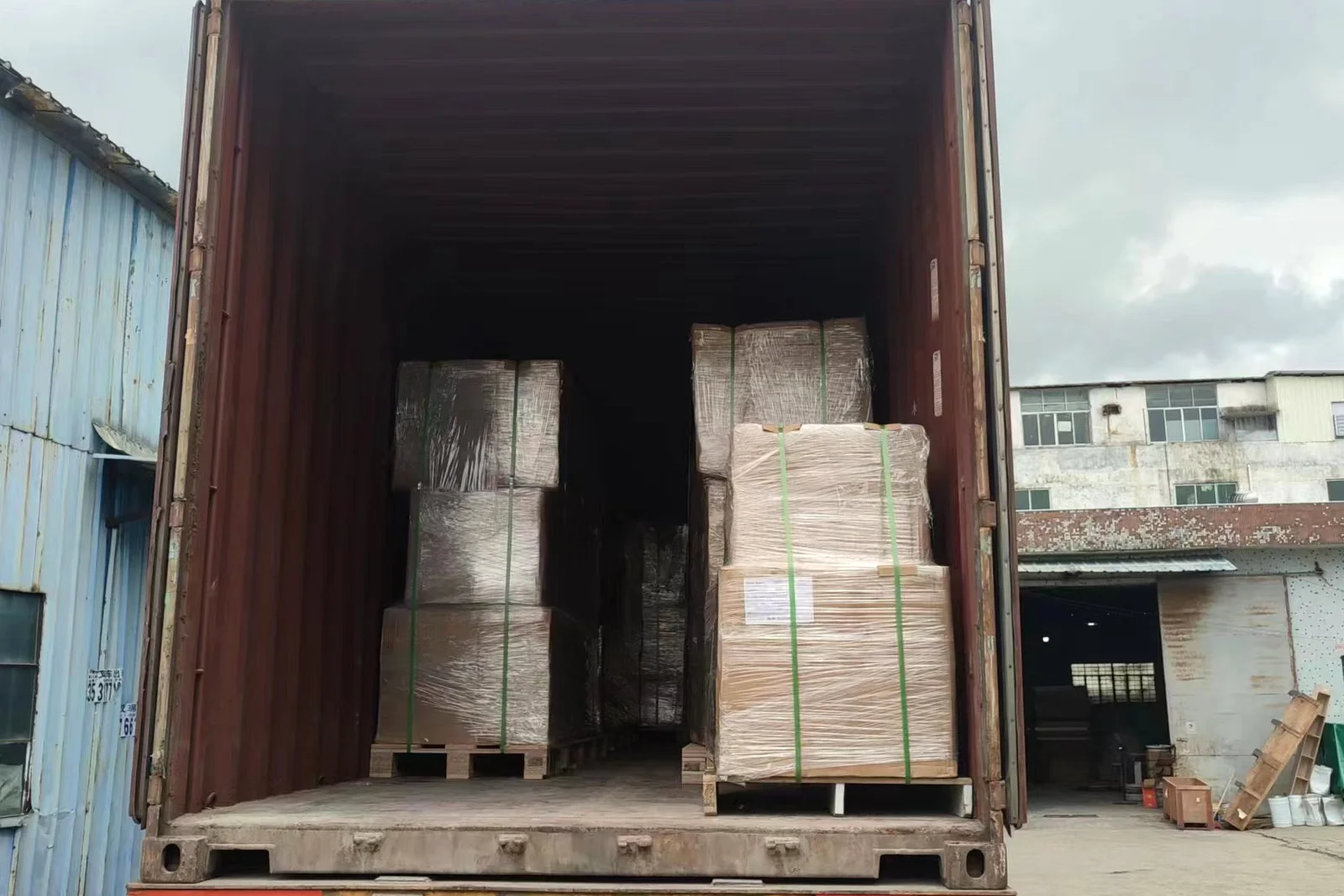
Under FOB the tariff line is discovered at the port - which is the line most buyers never see in a CIF quote, and the one that usually arrives with a storage fee for the days the box sat unresolved. The full mechanics of the DDP tail - entry, the tariff lines inside the per-foot number, clearance and drayage - are walked through in the import walkthrough. Ours runs on the published windows: 18-22 days to the US West Coast, 32-40 days to the US East Coast - the same stack that moved the Texas whole-house villa and the Houston illuminated-island kitchen to the dock as single fixed numbers.
A worked landed-cost table for one 40HQ
One 40-foot high-cube of flat-packed standard matte runs holds roughly 400 linear feet of base + wall on our packing plan. Take it at the entered value the worked example assumes - $249 per linear foot for standard matte base + wall, the same unit the per-foot guide breaks down - and here is what the October 2026 duty stack does to it. Two scenarios, because the anti-dumping leg is the only variable that moves:
| Line (one 40HQ ≈ 400 linear feet) | Scenario A - exporter with a separate rate | Scenario B - no rate of its own |
|---|---|---|
| Entered value of the goods (assumption, derived from the $249 sample rate) | $48,200 | $48,200 |
| Section 232 wood products (+25% on entered value) | $12,050 | $12,050 |
| Section 301 China list, List 3 (+25%) | $12,050 | $12,050 |
| AD + CVD (10.02% AD + 9.51% CVD) | $9,413 | - |
| AD China-wide (251.64%), before any China-wide CVD | - | $121,307 |
| Duty subtotal | $33,513 (69.53%) | $145,407 (301.67%) |
| Ocean freight, ISF, broker, drayage, last mile (assumption, quoted per order) | $17,944 | $17,944 |
| Landed total to the dock | ≈ $99,700 (≈ $249 / linear foot) | ≈ $211,500 (≈ $529 / linear foot) |
The entered value and the freight tail are planning assumptions, labeled as such - the per-order quote replaces both, and it is the figure that matters. Duty percentages are all applied to the same entered value. Scenario B is not a prediction for your order; it is the default that applies when nobody ever assigned the exporter a rate, which is why the exporter's own AD rate is question three in the broker list below. The same box, a different exporter, and the landed cost more than doubles.
Which is why the tariff line is worth settling before the drawings are. If you are buying for resale or installing on contract, the duty calculation above is the part that decides whether a container of cabinets is a margin or a loss - and it is the part most quotes leave vague. The dealer and wholesale program carries the same landed-cost method with the tariff lines confirmed for your entry date; the contractor and builder program runs it against a project schedule. Both quote one duty-paid number to the dock, which is the only figure worth putting in a bid.
Five questions to send your customs broker this week
Copy the five, replace the bracket, send. A broker who answers all five in writing before entry is a broker who has cleared a container of cabinets - and the answers are yours to compare any two quotes against:
- "What HTS subheading do you plan to declare this cabinet line under, and what is the base (MFN) rate on that subheading today?"
- "Confirm the current Section 232 wood-products layer (heading 9903.76.03) for our entry date, and whether any scheduled rate step has been postponed."
- "What are the current AD cash-deposit rate (A-570-106) and CVD rate (C-570-107) for exporter [name] / manufacturer [name] - can you provide them in writing before entry?"
- "Which Section 301 actions apply to our codes on the entry date - List 3 at 25% on 9903.88.03, plus anything not yet imposed - and is any exclusion available?"
- "What is the total duty as a percentage of entered value, and who is importer of record under my terms?"
Run the same five against a DDP quote and you get something rarer: a supplier who can answer them, because a supplier who has cleared the container already knows the answers - and has carried the risk for the entries before yours.
FAQ
What tariff do Chinese kitchen cabinets pay to enter the US in 2026?
Was the cabinet tariff supposed to go to 50% in 2026?
What are AD and CVD duties, and why do two suppliers quote two different duty numbers?
Do door panels, drawer boxes and other parts count?
DDP or FOB - who carries the tariff risk?
Are cabinets from the UK, EU or Japan taxed the same?
What changes after November 10, 2026?
Sources: Section 232 - White House proclamation annex, Lumber and Timber 232 (Sept 29, 2025) and the Dec 31, 2025 adjustment fact sheet (whitehouse.gov). Section 301 List 3 at 25% - USITC publication 5042, Wooden Cabinets and Vanities from China, which sets out 9403.40.90 / 9403.60.80 / 9403.90.70 at 25% under 9903.88.03 from May 10, 2019. The forced-labour duty and its exemption - Federal Register, July 28, 2026, notice 2026-15181, U.S. note 52(f)(4) to Chapter 99. AD final results, April 23, 2026 (91 FR 21788); CVD final results, March 13, 2026 (91 FR 12349); AD and CVD orders, April 21, 2020 (85 FR 22126; docket C-570-107). This guide explains, it does not advise: classification and rate confirmation at entry are your broker's call, and rates move by proclamation.