A wardrobe quote should read like a parts list, not like a number. The buyer who has been burned before knows what that means: two factories can send you the same rendered image, and the difference between the two prices lives in eleven lines of a specification nobody bothered to write down. This is the anatomy of a closet quote the way we issue ours - every line item named, the standard behind it stated, and the exclusions written where a buyer can find them instead of discovering them at the container.
The short version
Eleven lines. If a quote from a wardrobe factory does not resolve into these, the total is not comparable to anything:
| Line | What it should state | What its absence means |
|---|---|---|
| 1. Carcass board | 18mm E0-grade plywood, ENF available | You are being quoted on board you cannot inspect |
| 2. Edge banding | 2mm hot-melt on every cut edge | Open particleboard core after a year |
| 3. Door type | Hinged or sliding, count, glass or mirror | The render and the delivery are different products |
| 4. Hinge rating | Brand, cycle rating, max door weight | Soft close that is soft for a season |
| 5. Runner rating | Extension type, kg per pair | Drawers that bind in year two |
| 6. Drawer configuration | Count, sizes, which bays | "Drawers" as a hope |
| 7. Interior fittings | Every pull-out named individually | Fittings that never ship |
| 8. Lighting | Layers, colour temperature, driver positions | A wardrobe you light with a lamp |
| 9. Finish | Board grade, finish system, custom colours | "White" that arrives cream |
| 10. Packing and compliance | Crate standard, ISPM 15, destination voltage | A claim the port will read differently |
| 11. Exclusions | Installation, local electrical, oversize freight | The total that is not the total |
Lead time is the line that follows, and ours runs 12-16 working days from drawing sign-off, everything kitted with the run.
The carcass lines: board, edge, back panel
The first two lines are the ones that survive the longest, because they are the ones you cannot see after installation. Our standard carcass is 18mm E0-grade plywood - three-quarters of an inch - with ENF available on request for buyers whose destination writes it into the contract. Every cut edge carries 2mm PVB hot-melt edge banding, not a thin melamine tape that lifts at the first humidity swing. On wardrobe runs the back panel is 9mm in the same board, so the carcass is one material family from face to back.
Why the quote must name it: board grade is the single line where "looks identical, costs different" is truest. An 18mm carcass in E1-grade chipboard and an 18mm carcass in E0 plywood are the same wardrobe in a photograph and a different wardrobe in a ten-year kitchen. If the quote does not state the board, the board is whatever the production floor has. The same logic runs through the formaldehyde letters themselves - we have written the E1, E0, ENF and CARB P2 comparison as its own guide, and a quote line without a letter is a line you are not allowed to trust. The carcass standard is the one we publish on the closets and wardrobes page, so a quote can be compared against any other factory's on the same sheet.
The door and rail line
The third line is where a walk-in closet quote diverges from the render. Hinged or sliding, how many leaves, whether any of them are frosted glass or full-length mirror, and the width of each leaf - all of it specified, because a sliding system is a different product from a hinged one at the rail, at the floor and at the quote. Sliding runs carry a rail system and a floor or overhead track; hinged runs carry hinges sized to the leaf. Our hardware standard covers both: single doors up to 28kg, on the hinge line.
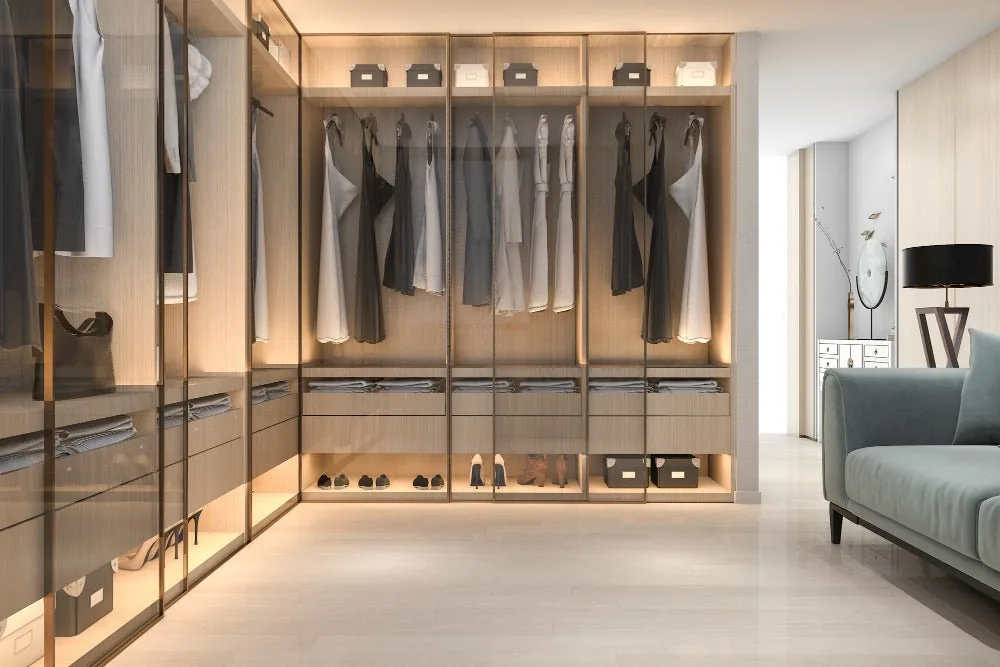
The rendered image in the door section of most factory decks shows glass-front runs, because glass reads as premium. That is fine - glass is a line item we spec, frosted or clear, on the same plywood box - but the quote has to say which glass is on which leaf. A quote that says "glass doors" without a count and a specification is a quote that will deliver "glass doors" at a different price than the one you compared.
The hardware lines: hinges, runners, drawers
Lines four through six are where "soft close" either earns the phrase or loses it. The hinge line should carry the brand, the cycle rating and the maximum door weight. Ours is Blum soft-close rated at 50,000 cycles, with DTC available on request, and a 5-year hardware warranty aligned with the manufacturer's own. The runner line should carry the extension type and the load rating: full-extension runners at 35-45kg per pair on our standard. The drawer line should say how many, in what sizes, in which bays, and which are soft-closed.
We have written the hardware vocabulary as a standalone guide, because a buyer comparing two quotes should be comparing "50,000 cycles, 28kg" against "soft close" the way a lawyer compares a clause against its absence. One of the two numbers is doing the work; only one of them can be checked at the factory. If the second quote cannot produce a cycle rating, it has not rated its hinges, and the warranty behind them is an interpretation.
The interior fittings line
The seventh line is the longest on the sheet and the most frequently compressed: pull-outs, named individually. Shoe racks by type and position, jewellery drawers by size, valet rails, trouser stations, bench seating, upholstered drawers - each one a row, each one a part number, each one kitted. This is the line a buyer who has ordered fitted furniture before reads first, because it is the line where a factory quietly converts "included" into "available as an option" after the deposit lands.
The rule we apply: if it is drawn, it is quoted; if it is quoted, it ships. Fittings are the items a wardrobe is bought for, and a quote that lists them as a single "accessories" row is telling you the accessories are negotiable. The shoe-storage and jewelry-display guides on this site show what individual naming looks like in practice - a rotating tower is a different part from a fixed rack, and only the first one is in a quote that names it.
The lighting line
The eighth line is the one buyers skip in the render and regret in the room. A complete quote states the lighting in three fields: which layers (cove wash, integrated upright strips, task light inside fittings), which colour temperature (we spec 3000K in garment bays, 4000K at any mirror or care station), and where every driver lives (a marked, serviceable access panel, never buried in a carcass). Our closet lighting guide walks through each layer, but on the quote the lighting is one row with three sub-rows, and the voltage is the destination's - 120 V or 230 V - not the factory's.
Lighting belongs in the quote because its failure mode is a rebuild: a strip taped inside a finished upright is a wardrobe apart when it dies. If a factory's quote does not mention drivers, the drivers do not have positions, and the positions do not exist on the drawing.
The finish line
The ninth line closes the gap between "the render" and "the delivery". Board grade (line one) and finish system are different things: melamine, veneer or painted, and whether painted runs to the full RAL palette for a specified colour. A quote that says "white oak finish" without naming the finish system is describing a photograph, not a product. We have written the melamine-versus-plywood-versus-veneer comparison as its own guide, and the finish line on the quote is where that comparison becomes a contract instead of a mood.
Two practical notes. First, mixed finishes within a single run are part of the finish system, not an exception, and the quote should show them as separate rows so a change to one does not re-price the others. Second, the finish is the one line you can verify before the money moves: a sample kit ships with the first quote, and the material wall in our 30,000 m2 showroom carries every finish in sample form, viewable in Foshan or over a 30-minute video tour the same week. A quote you cannot touch is a quote you are buying in faith.
Packing, compliance and the destination
The tenth line is the one that decides whether the wardrobe arrives as a wardrobe. Wooden crates are treated to ISPM 15 - what that means for a cabinet shipment applies identically to wardrobe runs; LED hardware is kitted at destination voltage; and the duty-paid scope is stated on the quote itself, so the landed number is the number. Packing on a quote is not a courtesy line: a crate standard that fails the port inspection converts a duty-paid quote into a destination charge nobody budgeted.
What a good closet quote excludes
The eleventh line is the most important one and the one that is most often missing: exclusions, written. Installation labour is the site crew's scope, not the factory's - the wardrobe arrives kitted, and the local installers hang it from the drawing set. Connection to the room electrical circuit is the site electrician's, with labelled tails left at each driver position. Oversize freight beyond the quoted route is a change order, not a surprise. And the warranty covers the hardware and the workmanship it is tested against - 5 years on the hardware line - while damage in handling or installation sits with whoever was handling it.
These exclusions are not a dodge; they are the line that makes the total true. A quote that includes everything includes a factory guessing at your site, and the guess is paid for in the total. The ordering flow itself - drawing, sign-off, production, inspection, shipment - is written up in our how-it-works page, and the exclusions above sit at the edges of that flow exactly as stated.
How to compare two closet quotes
When two quotes arrive for the same walk-in closet, do not compare the totals. Line them up against each other, column by column, and read only the rows where they differ. The carcass row tells you the board. The hinge row tells you whether soft close is rated or promised. The fittings row tells you what ships. The lighting row tells you where the drivers live. The exclusions row tells you what the total is not.
A practical method: take the eleven lines above as the comparison sheet, paste both quotes into it, and treat every empty cell as a negotiation, not a saving. Where the two quotes differ in specification rather than in arithmetic, the question to the cheaper one is never "why is it cheaper" but "what is the row". A factory that writes eleven rows can answer that question in a sentence; a factory that writes one total cannot answer it at all, and the answer to "what is the row" in that case is the reason the row was missing.
Bring both drawings with you when you compare, because a quote is a statement about a drawing: the same room drawn two ways produces two legitimate totals, and the only comparison that means anything is the same sheet read twice. Send the wall lengths, a photograph of the room and the list of what has to live in it, and the drawing comes back with every bay placed - which is also the moment the quote stops being a number and starts being a specification you can hold up against the container.
Where the photos came from
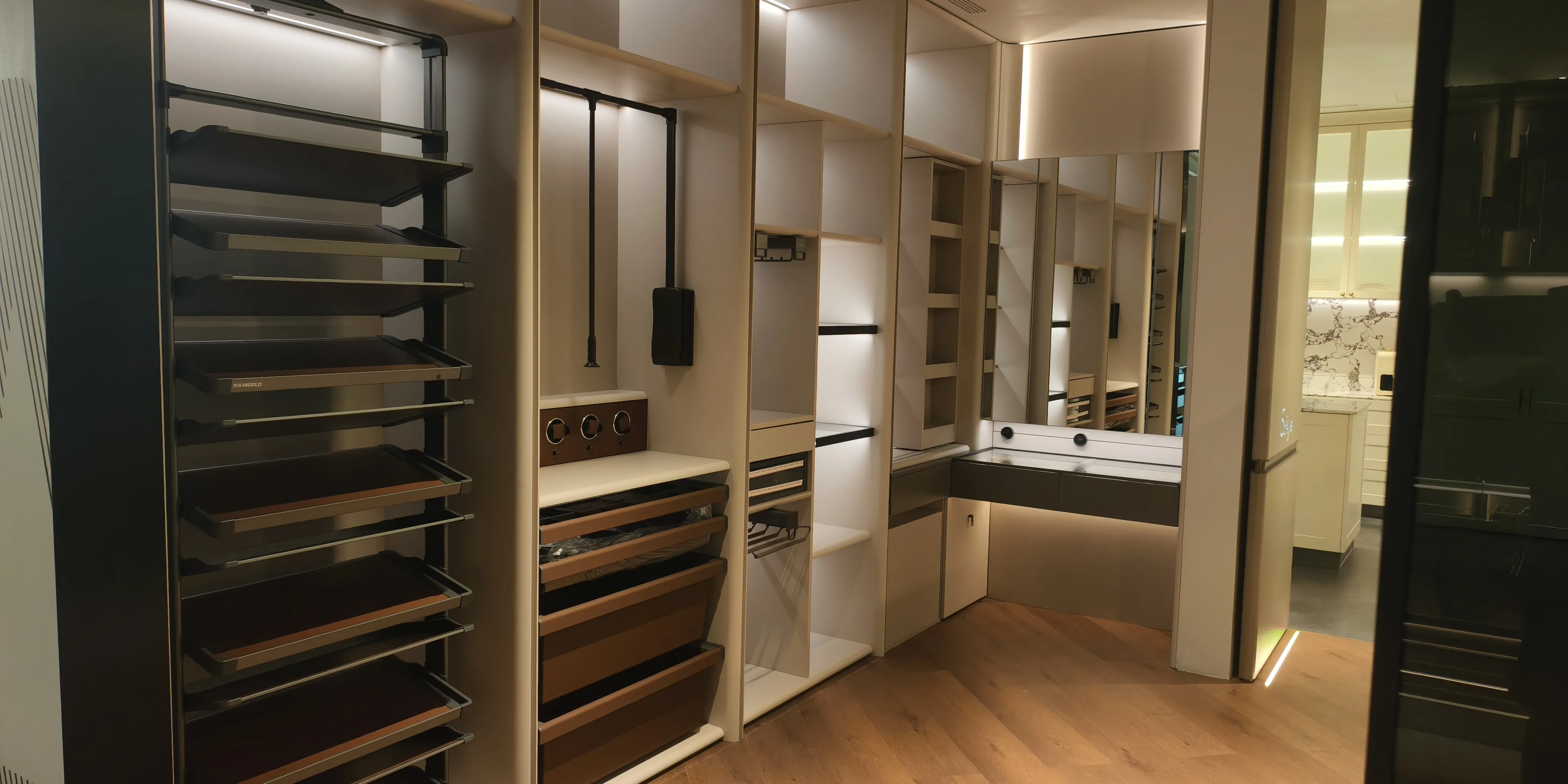
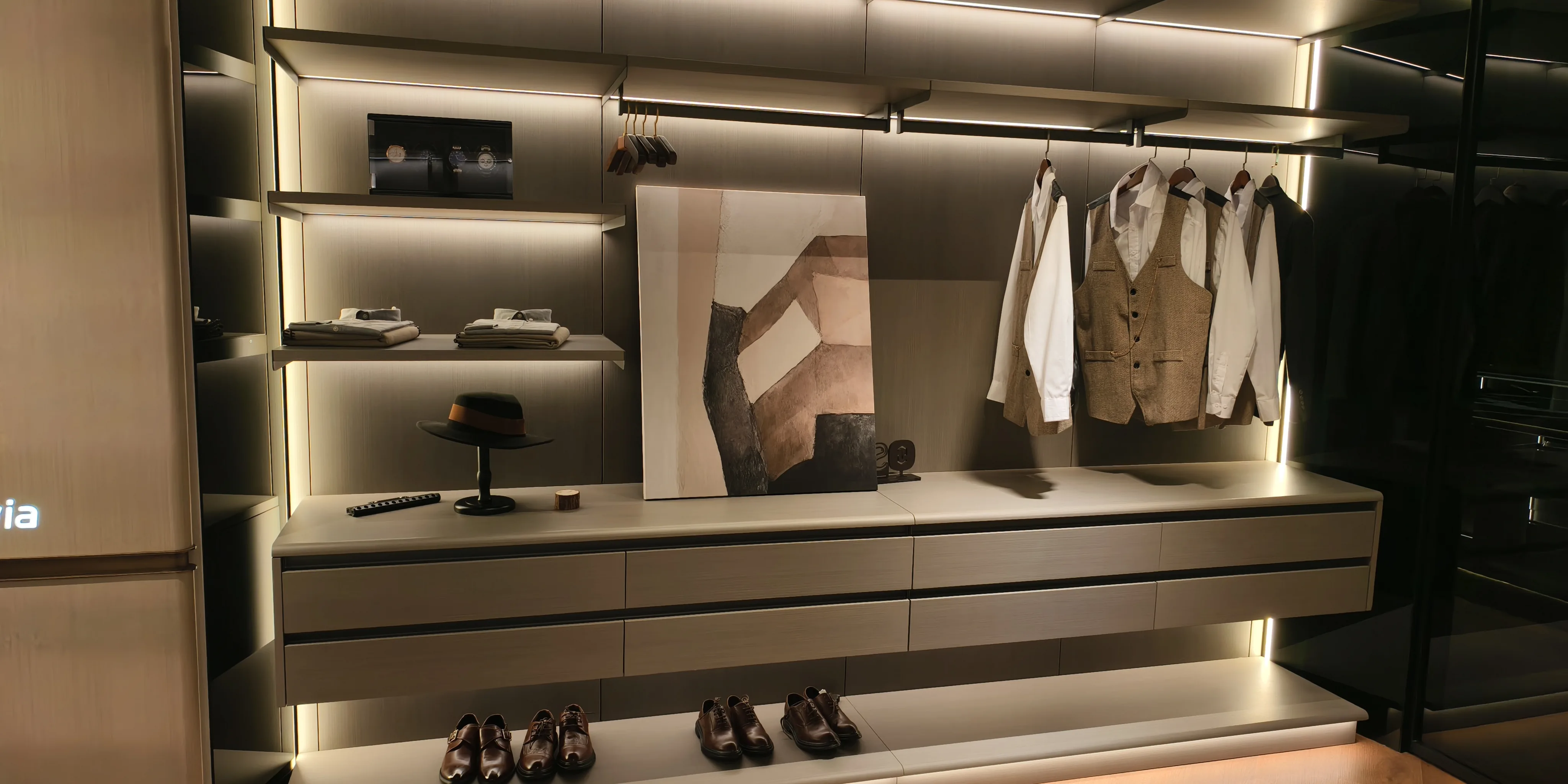
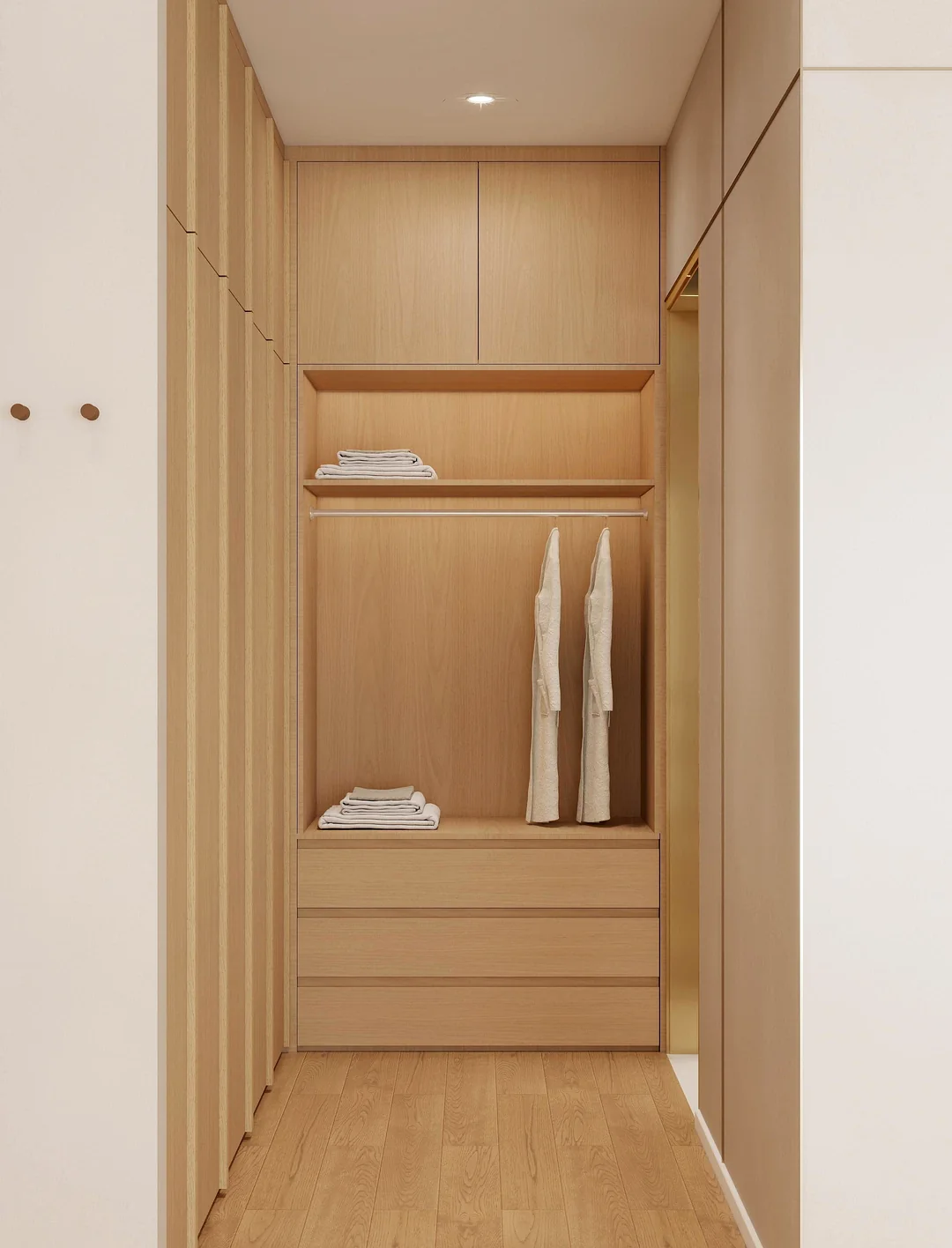
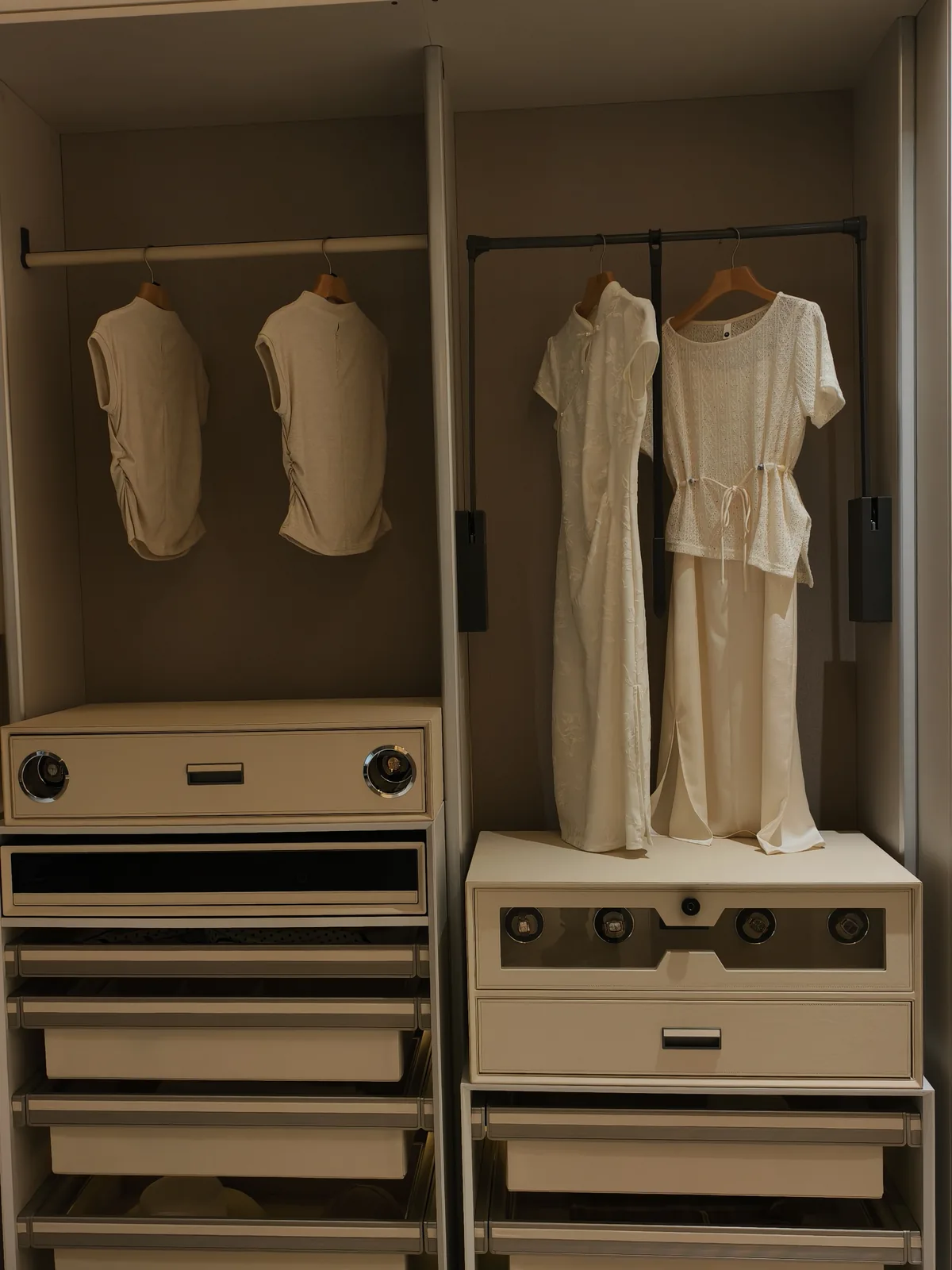
The hanging-bay and drawer photograph was taken in our partner's showroom - shot, not rendered, and not from a customer site. The two wider layouts are labelled renderings, and we label them the same way on the drawing set: a render is a design tool, a photograph is evidence, and a quote is a contract. If you want photographs from installed projects instead of showroom or render, ask and we will send what we have from the relevant market.
FAQ
What does a walk-in closet quote from a Chinese factory include?
The carcass board and edge banding, the door system, rated hinges and runners, drawers and individually named fittings, lighting with driver positions, the finish system, packing to ISPM 15, and duty-paid freight to your destination - with installation, the local electrical connection and oversize freight written as exclusions.
Why don't you publish a price list for wardrobes?
Because the layout is drawn to your room, so the number only exists against your drawing. We quote per system, shipped duty-paid, and a catalog price for a walk-in closet would be a price for a different product.
How is a walk-in closet quote measured?
Against the signed drawing. Long straight runs are broken down per linear foot on the same sheet, and U-shaped or island layouts are quoted as systems - which is why the drawing comes before the number, not after.
Can I see the finish before I commit to a quote?
Yes. A sample kit ships with the first quote, and the material wall in our 30,000 m2 showroom carries every finish in sample form - viewable in Foshan or over a 30-minute video tour the same week.
What is the lead time once the quote is accepted?
Twelve to sixteen working days from drawing sign-off, with fittings, hardware and lighting kitted with the run rather than ordered after it.
What happens if I change the design after signing the quote?
The change is made on the drawing first, and the affected lines are re-quoted before production touches the board - a drawing change without a line-item change is how 'included' quietly stops being true.