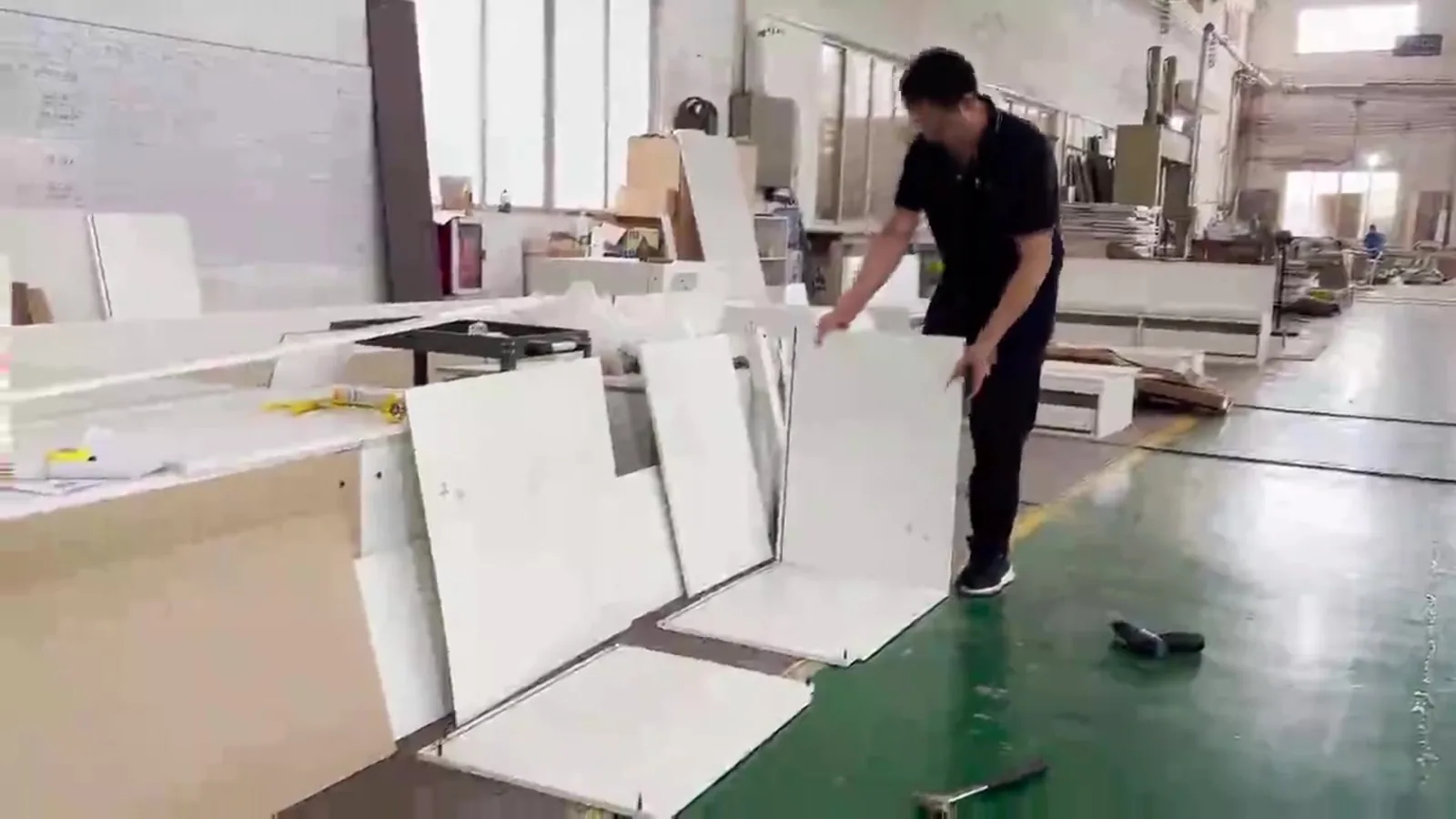
Cabinet installation support runs at three levels, and almost every quotation in this trade assumes one of them without saying which. The first is drawings only: the crate arrives, a local crew hangs it. The second is drawings plus an introduction to a crew we have worked with in that market. The third is our own team on site, which we will do when a project justifies the travel, at a cost that is quoted separately from the cabinets.
The level matters less than whether it is stated. What decides who pays when something is wrong is not the level, and it is not goodwill. It is the drawing. Everything installed to the drawing is our problem. Everything installed off it is the installer's.
The three cabinet installation support levels, side by side
| Level | Who contracts the crew | Who carries installation risk | Fits |
|---|---|---|---|
| Drawings only | Client | Client and their installer | Markets with a competent local trade; buyers with a regular fitter |
| Drawings plus a crew introduction | Client still contracts them | Client and that crew | First project in a market, or a client with no local contacts |
| Our team on site | Us | Us, for the installation scope | Programme work, repeatable unit types, or a date that cannot slip |
Two things are true of all three. The cabinet price is cabinets only, freight and installation sit outside it, and a written drawing set is included at every level because nothing else works without it.
The middle level is the one most buyers should want and few ask for. We are not a licensed contractor in Ohio or Queensland and we do not pretend to be. What we can do is tell a client which crews have hung our cabinets before, what they charged, and what went wrong on the last job. That is worth more than a name off a directory, and it costs nothing to ask for.
Why drawings-only cabinet installation support is the norm, not a gap
A US cabinetry wholesaler states its own position about as plainly as it can be put: they do not offer installation services, they sell the cabinets and your local installer hangs them, and that separation is normal in the cabinet trade.
It is normal for reasons that have nothing to do with willingness. A factory in Foshan sending a crew to a site in Texas is exposed to visa timing, a two-week round trip for a three-day job, tooling that cannot fly, and liability in a jurisdiction where it holds no insurance. Every one of those costs lands in the cabinet price whether the client uses the service or not.
So the honest question is not "will you send a team." It is "who is going to hang this, and what does your drawing give them." A supplier who answers the second question properly has done more for the install than one who promises the first and then subcontracts it to whoever is free.
The line runs along the drawing
The split below is not ours; it is how cabinetry warranties work across the trade, in every market we ship to.
| What went wrong | Whose issue it is |
|---|---|
| Box out of square, door warped, finish peeling | Factory |
| Hinge or runner defective out of the box | Factory (hardware warranty) |
| Cabinet not level, or not plumb to the wall | Installer |
| Cabinet pulled off the wall | Installer (fixing, not the box) |
| Doors out of alignment after hanging | Installer (adjustment) |
| Filler or scribe gap at an out-of-square wall | Installer, unless the filler was specified by us |
| Damage during handling, assembly or installation | Installer |
| Damage found on delivery, before signing | Supplier and carrier |
Two lines in that table carry most of the disputes.
The first is filler and scribe. Cabinets are built square. Walls are not. A 6 mm gap at the end of a run is not a defect in the cabinet, it is what a filler panel is for, and whether that panel ships with the crate or gets cut on site is a decision that has to be made before the order, not after the crew arrives.
The second is damage found after signing. Most suppliers will not accept a damage claim once the delivery paperwork is signed, because the signature is treated as confirmation that the goods arrived in good order. That rule applies to us too. It is the single most expensive five minutes in the whole process.
One more consequence is worth stating plainly: an installation that ignores the drawing can void the factory warranty. If a cabinet is fixed through a service void, or the run is set out to a different dimension than the approved set, the defect that follows is not a manufacturing one.

What the drawing has to carry for a local crew
Cabinet installation support lives or dies on the drawing. A crew that has never seen our cabinets can hang them from a good drawing set in a day, and the same crew will lose two days guessing from a bad one. Six things have to be in the package.
A datum, not a dimension. One finished floor line and one wall line to measure everything from, so the crew is not building a chain of measurements off each other.
Wall geometry as surveyed. Corner angles, bow in the wall, and where the plaster is out. If a wall is 8 mm out over three metres, the drawing should say so and the filler should be sized for it.
Service positions. Sockets, water, waste, and the extract duct, with the clearances the cabinet needs around them. This is where a run gets rebuilt because nobody checked where the pipe actually came out.
Appliance openings by model. Not by nominal size. A 600 mm oven housing is not a 600 mm opening, and the difference is discovered on site.
Unit numbering that matches the crate. Every box labelled to the drawing reference, so the crew can unload in sequence rather than opening everything to find out what is inside.
Filler and scribe ownership, in writing. Which panels ship, which the crew cuts, and what tolerance we are building to.
Where the money and the risk sit
Installation labour in the US runs roughly USD 50-250 per linear foot, or USD 100-700 per cabinet, with a full kitchen averaging around USD 6,191 and most projects falling between USD 1,935 and USD 10,766. Material is 50-70 per cent of a cabinet line item and labour 30-50 per cent, which is why a quote that lists only boxes is not a project budget.
Scheduling is more predictable than the price. An experienced installer hangs 8-12 cabinets a day on a clean job, so a 10x10 kitchen of 12-14 boxes is a one to two day install for a two-person crew, plus a day for significant scribe work. Flat-pack adds 20-30 minutes of assembly per box before anything is hung, which is 4-6 hours on a twelve-cabinet kitchen.
The risk side is where buyers get surprised. Across home installation work generally, damage during installation runs at 2-5 per cent, and close to 60 per cent of the disputes that follow are about who pays, how much, and how. That is not a reason to avoid a local crew. It is a reason to make three checks before one starts.
Ask for a certificate of insurance, with general liability and, where the crew has employees, workers compensation. Buildings with a management company will often ask for the building to be named as additional insured, and a crew that cannot produce the certificate is a crew that cannot get on site.
Confirm in writing what the crew is not doing. Countertop templating, plumbing connections, electrical, and appliance commissioning are usually outside a cabinet install, and every one of them is a line item somebody assumes is included.
Photograph the crate before anything is unpacked. Labels visible, corners visible, one wide shot per room.
What to ask any supplier, including us
Six questions, and the answers are checkable.
Which of the three levels is in this quote, and is it written down. Who is expected to contract the installer. Does the drawing include a datum line and surveyed wall geometry, or dimensions only. Which filler and scribe panels ship, and which are cut on site. What is the process if damage is found on delivery, and by when must it be reported. And if we send a team, what exactly is in scope and what is excluded.
A supplier who answers all six has an installation position. One who answers three has a shipping arrangement.
FAQ
Does the cabinet price include installation?
No. Cabinet prices are for cabinets - boxes, doors, drawers and hardware - and freight, duty and installation sit outside them. Installation labour in the US runs roughly USD 50-250 per linear foot or USD 100-700 per cabinet, with a full kitchen averaging near USD 6,191. Budget the two numbers separately and hold them side by side before committing.
Will you send a team to install the cabinets?
We will, when a project justifies the travel, and it is quoted as a separate line rather than folded into the cabinet price. That is the third level of cabinet installation support. The default is drawings only, which is the norm in this trade: a US cabinetry wholesaler describes its own model the same way, selling cabinets while the local installer hangs them. For most projects the faster and cheaper route is a competent local crew working from a complete drawing set.
Who is responsible if a cabinet is damaged during installation?
The installer. Damage during handling, assembly or installation is not covered by the factory warranty, and most suppliers will not accept a damage claim once the delivery paperwork is signed. That is why the crate gets photographed and inspected before anything is unpacked. Damage found on delivery, before signing, is a supplier and carrier claim instead.
Can a bad installation void the cabinet warranty?
Yes. Manufacturer warranties generally exclude improper installation, modification after delivery and damage from excess moisture or temperature. If a cabinet is fixed in a way that blocks a service void, or a run is set out to dimensions other than the approved drawing, the resulting defect is treated as an installation issue rather than a manufacturing one.
What should be in the drawing set for the installer?
Six things: one datum line to measure from rather than a chain of dimensions, wall geometry as surveyed including corner angles and bow, service positions with clearances, appliance openings by model rather than nominal size, unit numbering that matches the crate labels, and a written statement of which filler and scribe panels ship versus which are cut on site.
Who pays if the wall is not straight?
The cabinet is built square and the wall is not, so the gap is closed with a filler or scribe panel - and that is installation work. What decides who pays is whether the filler was specified and shipped with the order. If our drawing calls for it and the panel is in the crate, it is our scope. If the crew cuts it on site from a wall nobody surveyed, it is theirs.