
Walk-in closet shoe storage is the one part of a walk-in wardrobe where buyers change their mind twice: once when they count the shoes, and once when they see the column the shoes have to live in. The count decides the fitting. The column decides whether it physically fits.
The short version
We build three shoe fittings into walk-in closet shoe storage runs, and which one lands where is a drawing decision, not a catalogue choice:
- Rotating towers - a central spindle carries tilted shelves that swing 180 degrees, so both faces of the column are reachable without moving your feet.
- Slanted shelves - fixed slats tipped a few degrees forward, the cheapest way to get pairs off the floor.
- Pull-out drawers - full-extension boxes with dividers, the tidiest option and the one that hides what it holds.
All three are made from the same 18mm E0-grade plywood as the hanging bays, edge-banded with 2mm PVB hot-melt banding on every cut edge, and hung on the same full-extension soft-close runners. None of them is a bought-in accessory: the dividers, the spindle, the slats are all cut on our bench and drilled to the same 32mm system holes as the rest of the box.
Rotating towers: the capacity play
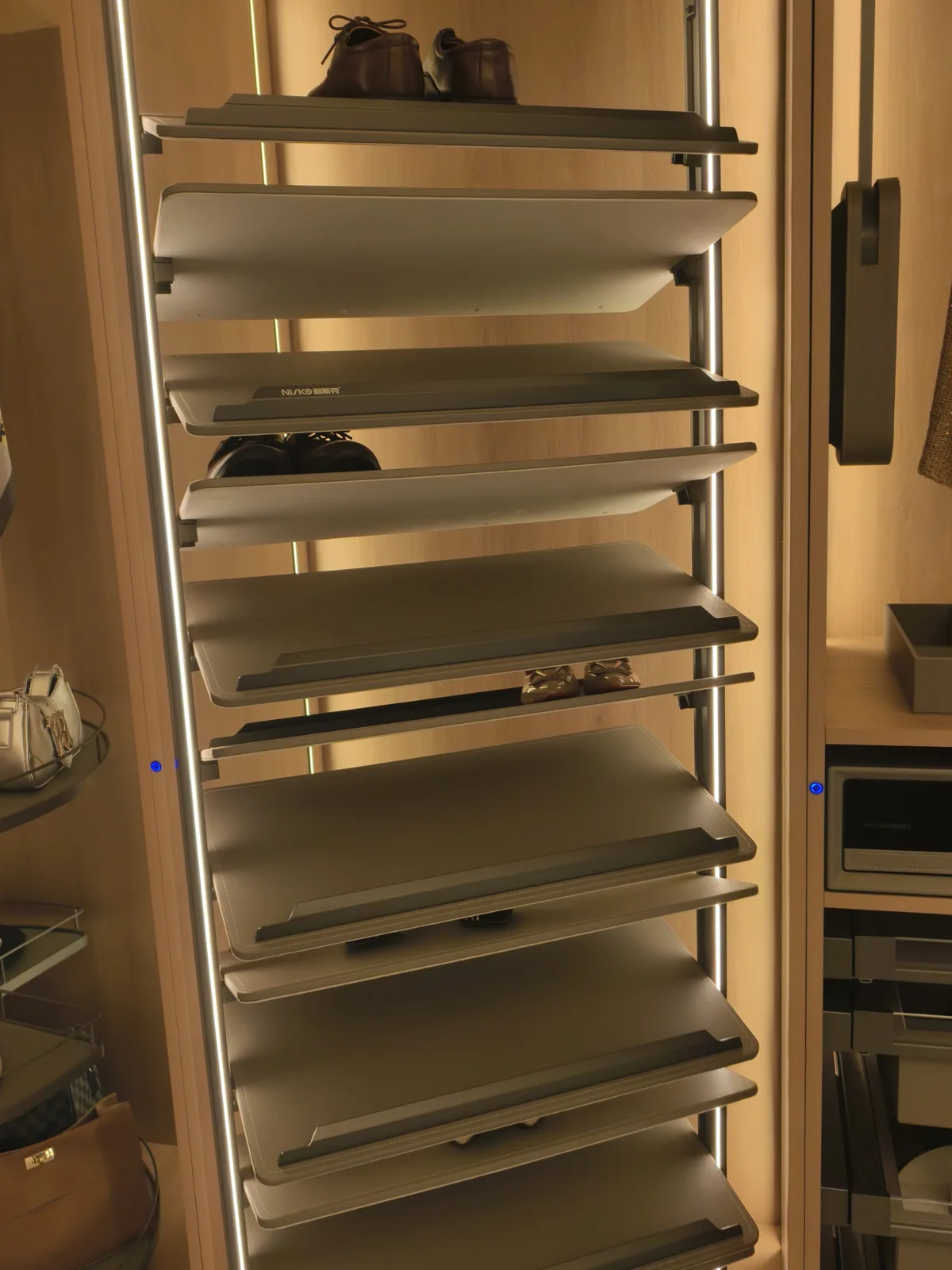
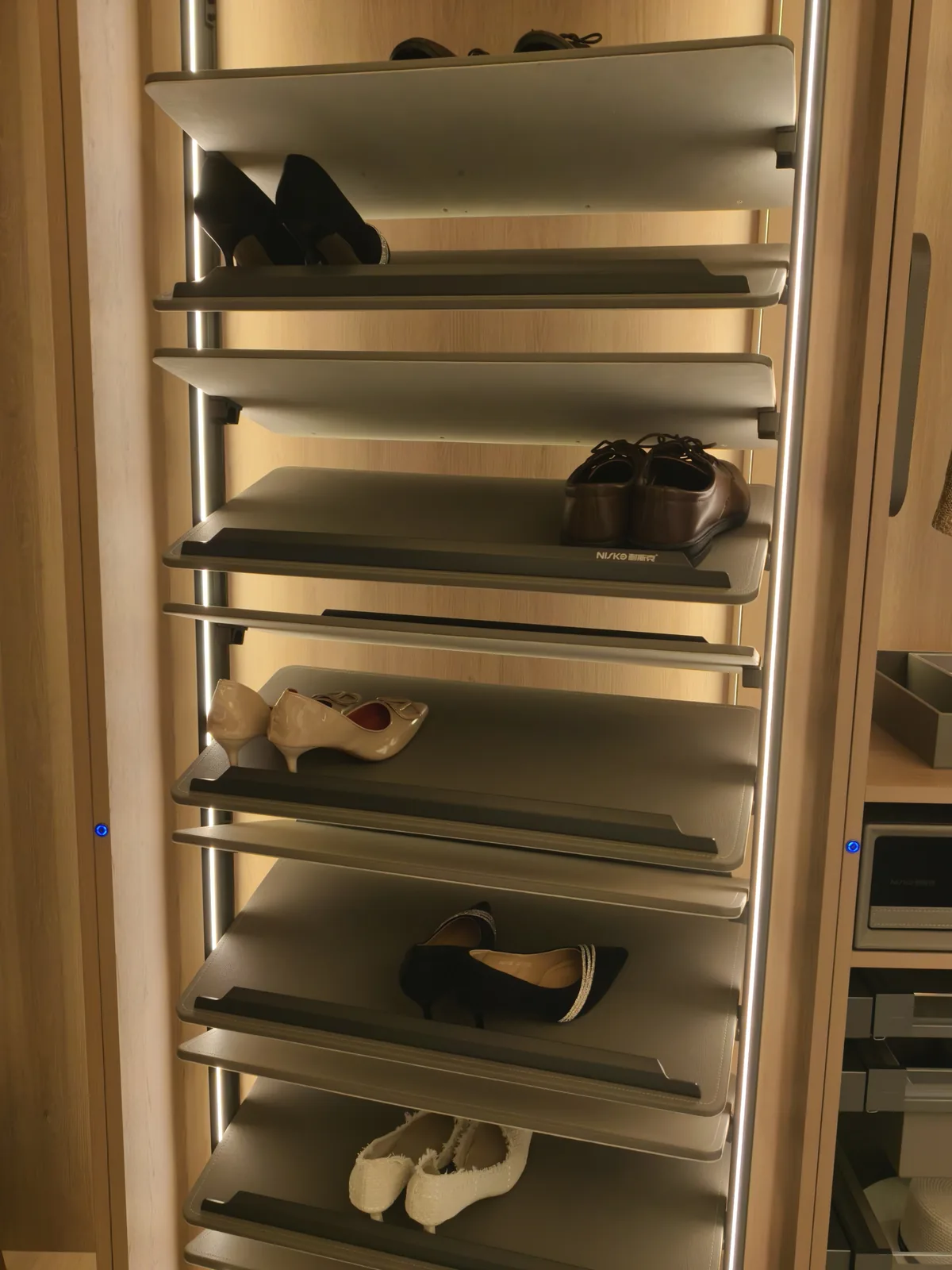
A rotating tower solves one problem: a narrow column with a lot of shoes in it. The shelves tilt forward so the heel of a boot clears the shelf above, and the whole stack rotates on a central spindle, usually a half turn, so you work the face pointing at you and swing the rest round.
Capacity is where the tower earns its space. The towers photographed in our partner's showroom hold eight visible pairs per 900 mm column, and taller columns hold more. Against a bank of slanted shelves in the same width, that is roughly double the pairs - which is why towers end up in the narrow pier between a hanging bay and a drawer bank, where nothing else works well. The tower carries its light on the uprights rather than the rotating stack - the approach our closet lighting guide sets out.
The trade-offs are real. A tower is a fixed-depth fitting: it wants the full 24-inch wardrobe depth, and in a shallower run the shelves foul the door. Rotation adds a moving part, so we spec the spindle as a serviceable item - if it ever needs a replacement bearing, it is a two-screw job from the front, not a rebuild. And a tower shows everything: mixed footwear looks busy through a glass door, which some buyers love and others do not.
Slanted shelves: the low-cost play
Slanted shelves are slats - usually 18mm plywood to match the carcass - tipped forward four to six degrees so shoes sit with the toe down and the heel up, the way they sit in a shop display. No mechanism, no moving parts, no hardware beyond shelf pins.
That simplicity is the point. Slanted shelves cost less and hold more pairs at a glance; drawers keep dust off and hide clutter - choose slants for a rental-grade wardrobe and drawers for an owner-occupier one. If the wardrobe is a staging piece for a rental or a guest room, slants are usually the right call: a shelf can be re-drilled, re-angled or removed in ten minutes, and losing it costs a shelf, not a runner set.
The limit is depth etiquette. On a 600 mm internal depth, a slanted shelf comfortably takes three to four pairs of flat shoes; boots need the shelf spacing opened up, and once you are spacing for boots you are back to tower economics. Slants also do nothing for dust - in a walk-in with an open plan and no doors, that matters less than people think, but in a glass-fronted wardrobe it is the first thing a buyer notices after a month.
Pull-out drawers: the tidiness play
A pull-out shoe drawer is the same box we build for socks and accessories, divided rather than left open: two or three pairs per drawer, toe to heel, on full-extension runners so the whole box comes out to the aisle and you can see the back row.
Yes - every pull-out we build ships on full-extension soft-close runners rated 35-45 kg per pair, so a loaded drawer does not slam. That rating is not a safety margin for the drawer; it is what lets a 900 mm box hold a row of winter boots without the runners sagging mid-travel. The soft-close matters in a walk-in the way it matters in a kitchen: drawers are the fittings guests touch, and a slam in a quiet room is the detail clients remember.
Dividers are where factory-built beats aftermarket. A foam or plastic insert bought later is cut to a nominal box size, not to your box, and it shifts every time the drawer opens. Our dividers are cut to the internal dimension, edged with the same 2mm PVB banding, and pinned to the box base - they are part of the carcass, not a tray sitting in it.
How we choose walk-in closet shoe storage
There is no single best: a rotating tower for volume, slanted shelves for budget, pull-out drawers for tidiness - and most walk-in projects we build mix two of the three in one run. The decision tree we run on every wardrobe drawing is short:
| Option | Capacity in a 900 mm column | Mechanism | Best for |
|---|---|---|---|
| Rotating tower | about 8-12 pairs | 180-degree rotation on a central spindle | narrow columns with high volume |
| Slanted shelves | 3-4 pairs per shelf | none - fixed slats | budget builds, rentals, guest rooms |
| Pull-out drawers | 2-3 pairs per drawer | full-extension soft-close runners | dust-free storage under hanging bays |
Three inputs decide it: how many pairs, how deep the run is, and whether the wardrobe is glass-fronted. Volume plus narrow pier points to a tower. Tight budget or a staging wardrobe points to slants. Dust and clutter - or an owner who wants the shoes invisible - points to drawers. A typical owner-occupier walk-in we build mixes one tower in the pier, slants above eye level where pairs are grabbed by touch, and drawers at waist height where the good shoes live. The fittings sit inside the full wardrobe line on the walk-in wardrobe page, and how the design library arranges them is on the wardrobe design page.
The specs behind all three
Whatever the walk-in closet shoe storage fitting, the carcass around it is the same specification we publish on the wardrobe pages, so a quote can be compared against any other factory's:
- 18mm E0-grade plywood carcass (ENF on request), 2mm PVB hot-melt edge banding on every cut edge.
- Blum soft-close hinges and runner sets, tested to 50,000 cycles.
- Full-extension runners rated 35-45 kg per pair.
- 32mm system hole pattern - 32mm pitch, 5mm bores, 37mm setback - so shelves and fittings can be re-positioned without new drilling.
- Back panel 9mm plywood in the same grade as the carcass, not a paper-board back.
- Standard wardrobe depth 24 inch, with 14 inch as the option for shallow runs.
Depth is the spec that eliminates fittings early. A 600 mm internal depth takes slanted shelves and drawers; a rotating tower needs the 24-inch standard wardrobe depth we build to. If your run is shallower than that, say so in the first message - we will draw the pier as slants instead of quoting a tower that cannot swing.
What we quote and how long it takes
We do not publish walk-in closet shoe storage prices, and we would distrust a factory that did: the fitting is cut to your column heights, your pair count and your runner choice, so the number only exists against your drawing. Quotes are issued per linear foot, duty-paid, against the final drawing - the same basis as every other wardrobe line.
A wardrobe order runs 12-16 working days from drawing sign-off, including the shoe fittings, because they are built into the same boxes as the hanging bays. Nothing about a tower or a divider adds a step to the line; it is the same bench, the same drilling jig, the same edge bander. If you are comparing factories on lead time, compare like for like: a 12-day quote that excludes fittings is not a 12-day wardrobe.
Where the photos came from
Every showroom photo on this page was taken in our partner's showroom, not rendered and not shot on a customer site - the two towers here are the same fitting family photographed loaded two different ways. Renderings, where we use them elsewhere on the site, are labelled as renderings. If you want photos from installed projects instead, ask and we will send what we have from the relevant market.
FAQ
What is the best shoe storage for a walk-in closet?
There is no single best: a rotating tower for volume, slanted shelves for budget, pull-out drawers for tidiness - and most walk-in projects we build mix two of the three in one run.
How many pairs of shoes fit in a rotating shoe tower?
The towers photographed in our partner's showroom hold eight visible pairs per 900 mm column, and taller columns hold more.
Are slanted shoe shelves better than drawers?
Slanted shelves cost less and hold more pairs at a glance; drawers keep dust off and hide clutter - choose slants for a rental-grade wardrobe and drawers for an owner-occupier one.
How deep does a closet need to be for shoe storage?
A 600 mm internal depth takes slanted shelves and drawers; a rotating tower needs the 24-inch standard wardrobe depth we build to.
Do pull-out shoe drawers need soft-close runners?
Yes - every pull-out we build ships on full-extension soft-close runners rated 35-45 kg per pair, so a loaded drawer does not slam.
How long does a custom wardrobe with shoe storage take?
A wardrobe order runs 12-16 working days from drawing sign-off, including the shoe fittings, because they are built into the same boxes as the hanging bays.


