Formaldehyde limits are real, and they're the one spec in cabinetry that's measurable - which is exactly why the letters get misused. A label is a test result from a sample, on a date, under one of several methods. Strip that context away and "E0" is just a font choice. Here's the context.
The four labels, and what each actually measures
| Label | Standard | Limit (approx.) | Method |
|---|---|---|---|
| E1 | EU (EN 717-1) / widely adopted | ≤ 0.1 mg/m³ | Chamber test |
| E0 | China GB 18580 (common usage) | ≤ 0.05 mg/m³ | Chamber / 1P-2AG per version |
| ENF | China GB/T 39600-2021 | ≤ 0.025 mg/m³ | 1P-2AG desiccator / chamber |
| CARB P2 | US EPA TSCA Title VI (CARB Phase 2) | Ply ≤ 0.05 ppm; panel ≤ 0.09 ppm | AWPP desiccator |
Don't line the numbers up and rank them. A 0.05 in the mg/m³ column is not the same quantity as a 0.05 in the ppm column, and chamber vs. desiccator vs. AWPP test differently. What's true across all four: every one of them is stricter than the board that failed to be labeled at all. The letters are a floor, and each is a real floor.

How to verify a certificate is real
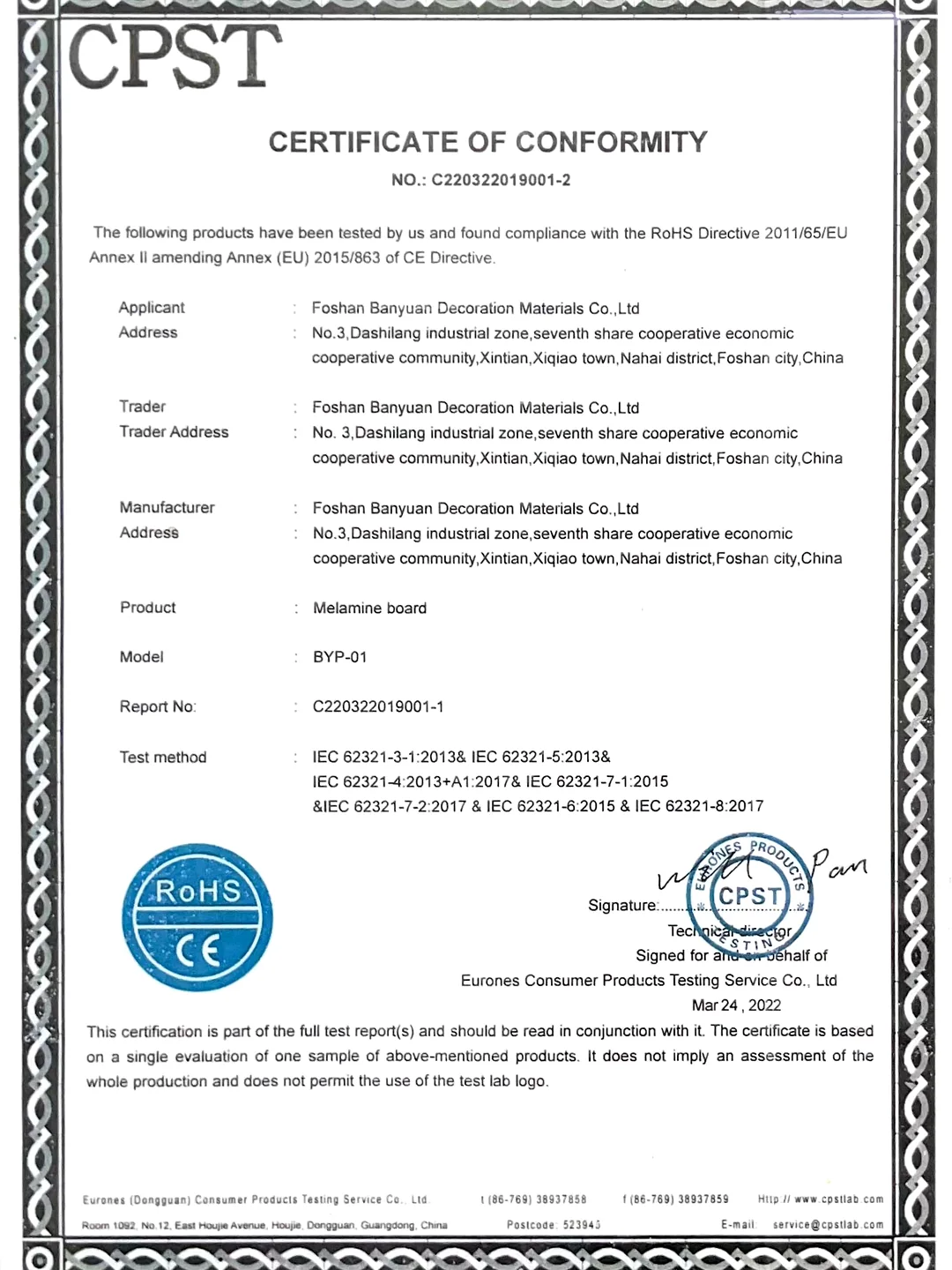
A "certificate" photo sent in a chat is not evidence. The evidence is the test report, and it has to carry:
- The lab's name and accreditation - a CMA/CNAS mark for Chinese labs, an EPA-recognized lab for TSCA Title VI.
- The sample identity: board type, grade, and ideally a lot or mill reference - so you can match it to the material in your order.
- The test date. Reports go stale; a five-year-old report proves five years ago.
- The method code. It tells you which column of the table above the number belongs to.
If a supplier can only produce a logo and a certificate number with no report behind it, treat the label as marketing and ask again - politely - for the report itself. The right answer is a two-page PDF.
Why the edge banding matters more than the letter
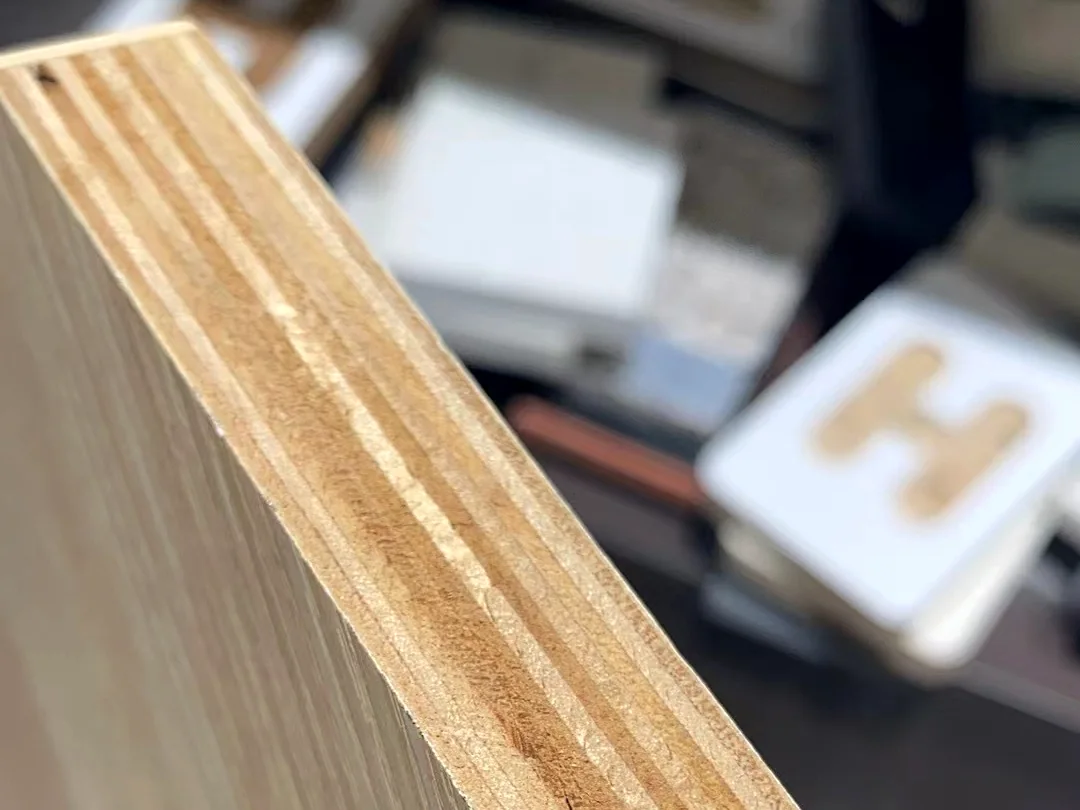
The board is only one surface. Every cut edge you can see - the inside of a drawer, the exposed sides of shelves, the ends of carcass boards - is a fresh cut made at the factory after the board was tested. That's where the most active release happens over the life of the cabinet, and the board's label says nothing about it.
The fix is mechanical, not chemical: a full-perimeter hot-melt edge band on every cut edge. The band is a physical seal over the cut fiber. On our line, edge banding is stage 3 of 10 - every board that leaves the saw gets a 2 mm PVB hot-melt band on all cut edges before it sees the drilling machines, and the banding is checked again at trial assembly. A cabinet built from E1 boards with open, unbanded edges can out-emit a cabinet built from E0 boards with full banding. The letter and the banding are two different controls - and buyers only get quoted on the first one.
What to ask on a quote
- "Which standard is the carcass board tested to, and can you send the report - with the lab name and date?"
- "Is every cut edge edge-banded, including drawer interiors and shelf ends?"
- "Is the same board spec used on doors, or are doors a different substrate?"
- "For US-bound orders: is the plywood TSCA Title VI compliant?"
Those four questions separate a supplier who tested the board from one who bought the label. And the answer to all of them is on the quality & warranty page - reports included, when you ask.
Standards referenced
Why the same formaldehyde class performs differently in two kitchens
A formaldehyde class is a test result, and a test result is a set of conditions. Two boards can carry the same letter and behave differently in a room, because three variables sit between the certificate and the kitchen.
The method differs. A chamber test measures what a panel emits into a controlled volume of air over time. A desiccator test measures a sample in a sealed container. They answer related but different questions, and a number from one cannot be compared with a number from the other. When a supplier quotes a class, ask which method produced it.
Machining opens the board. A certificate is issued against a finished panel. Cut that panel and the exposed core is what changes the emission, because the sealed surface is what held the number down. This is why edge banding is not a cosmetic line: 2 mm PVB hot-melt banding on all four cut edges is what keeps a certified panel performing like a certified panel after it has been cut, drilled and fitted.
Temperature and humidity move the result. Emissions rise with heat and humidity, so a board certified in a temperate test room and installed in a hot, humid kitchen is a different situation from the same board in a cold dry room. A specification that matters should name the class, the method, the report number and the banding standard - four lines, all verifiable, none of them adjectives.
FAQ
Is E0 board safe?
E0 is a class, not an absolute. It certifies that the board tested under the stated method emits formaldehyde at or under 0.05 mg per cubic metre, which is among the tightest limits in common use. What makes it hold in a finished kitchen is the sealing: the same board performs differently once it is cut, so the banding standard belongs beside the class on the specification.
What is the difference between E1, E0 and ENF?
They are three grades on the same ladder, with ENF the tightest. The letters describe the measured emission of a tested panel rather than an ingredient, which is why the report number and the test method matter as much as the letter: two suppliers can both say E0 and mean results produced in different ways.
Is CARB P2 the same as E0?
They come from different systems: CARB Phase 2 is a North American air-quality requirement for composite wood, and E0 is a board class in the Chinese and European labelling systems. A board can meet both, and a supplier quoting one is not automatically quoting the other. Ask for the certificate number and the issuing body rather than the label alone.
How do I verify a formaldehyde certificate?
Three checks. The report number should be searchable with the issuing laboratory or the certification body. The expiry date should be current, because certificates lapse and a renewal in progress is not the same as a valid certificate. And the scope should match the product: a certificate for one board type does not cover a different construction with a different core.
Does edge banding really matter more than the board grade?
For the emission you actually live with, yes - because the board is sealed at the factory and opened on the line. A certified panel with raw cut edges is a certified panel with unsealed core exposed at every edge, shelf and cut-out. Banding every cut edge with a hot-melt glue is what keeps the tested performance in the finished cabinet.
What do you use, and what is the report number?
18mm E0 plywood with formaldehyde at or under 0.05 mg per cubic metre under GB/T 39600, tested by the National Furniture Quality Inspection and Testing Center in Guangdong, report number SQ2405393, with ENF available on request. Every cut edge carries 2 mm PVB hot-melt banding, and the report travels with the order contract rather than sitting in a showroom folder.