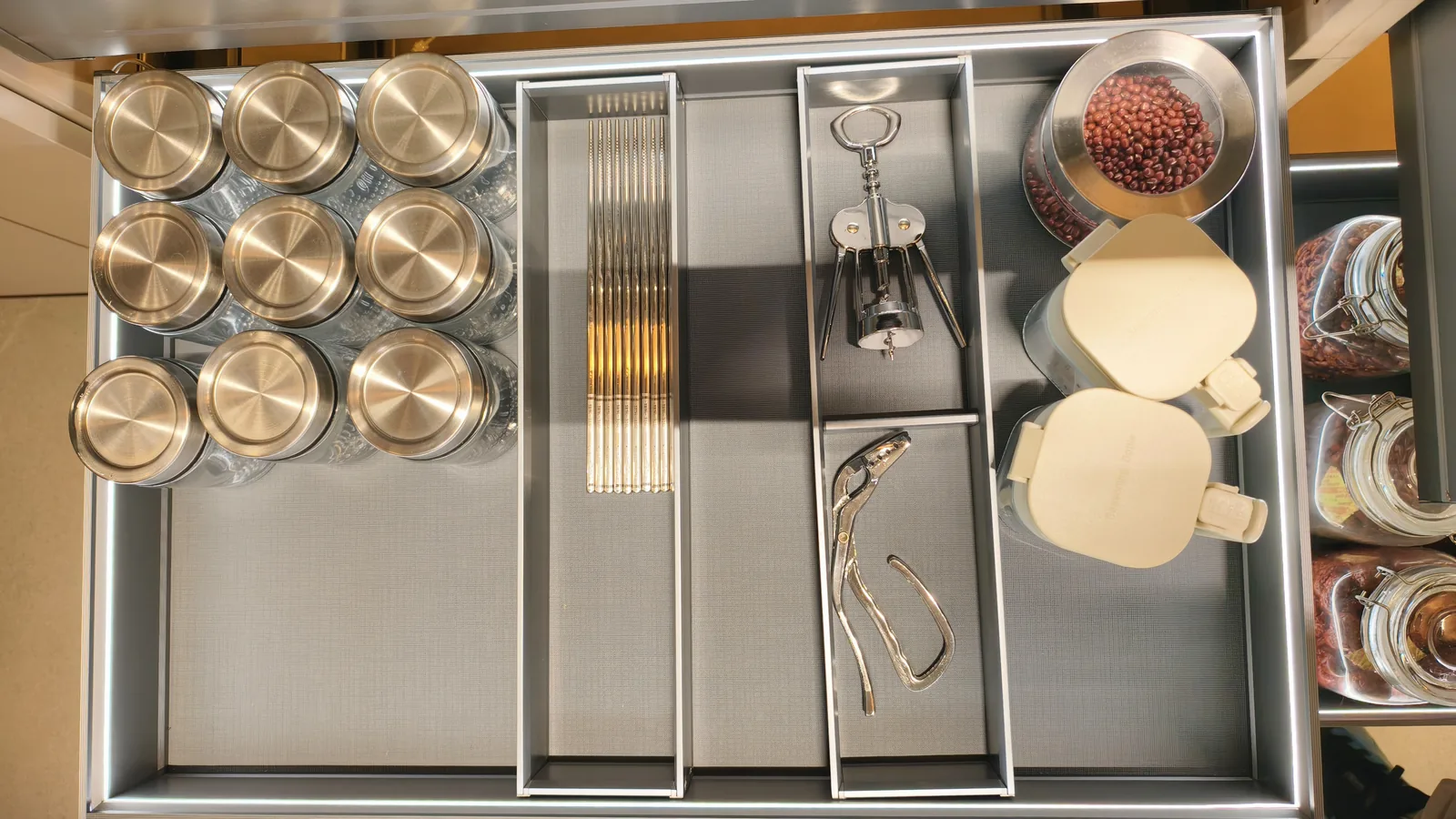
Every kitchen we ship has drawers that arrive already divided. Not with a tray of foam off the internet - with dividers cut on our bench, to the millimetre, around the list of what you actually keep in that drawer. This is the part of a fitted kitchen that aftermarket organizers get wrong most often, and the part buyers only notice after they have lived with the wrong version for a year.
The short version
- What they are: Kitchen drawer organizers, as we build them - dividers cut from the same 18mm plywood as the drawer, edge-banded and pinned into the box.
- How they are sized: to the internal dimension of your drawer and to your list - never to a nominal 500 mm or 800 mm tray.
- When the layout is decided: at drawing stage, before the boxes are cut, because the base is drilled then.
- What they run on: the same full-extension soft-close runners as every other drawer in the run.
What a factory organizer actually is
Kitchen drawer organizers are factory-cut dividers inside a drawer, edged and pinned like the carcass, sized to the box and to what you keep in it - not a foam tray bought to a nominal size.
The construction is the boring part and that is the point. A compartment is a strip of 18mm E0-grade plywood, banded on the top edge the same way the drawer front is banded, housed into a groove in the drawer base and pinned - not glued. Because it is pinned, it can be lifted out and re-positioned later, and because it is banded, the edge you touch is a finished edge rather than raw ply.
The layout is drawn per drawer, not per kitchen. The drawer under the hob gets compartments for the tools that live near heat; the drawer by the sink gets the cutlery; the tall unit near the breakfast bar gets whatever the household actually hoards. Two drawers in the same run almost never end up with the same compartment pattern, because no two drawers hold the same thing.
Why we cut them here, not ship foam
This is where kitchen drawer organizers earn their keep, and three reasons decide it - they only show up in use.
Are factory-built organizers better than aftermarket inserts? For a fitted kitchen, yes: our dividers are cut to the internal dimension of your box and pinned to the base, so they do not shift, and they travel with the drawer instead of arriving as a separate shipment.
First, fit. An insert is cut to a nominal drawer size; your drawer is cut to a real one. The two disagree by a few millimetres in every direction, and the disagreement is what makes an insert rattle, tilt or refuse to sit flat once a compartment is loaded.
Second, movement. A tray sitting loose in a box travels every time the drawer opens - slowly at first, then all at once, until the chopsticks are in the spoon compartment and the tray is wedged diagonally. A pinned divider is part of the box. It cannot travel because it has nowhere to go.
Third, the finish. An insert is a visible plastic object inside a plywood drawer; it reads as an accessory. A divider banded in the same 2mm PVB as the carcass reads as joinery, because it is.
How kitchen drawer organizers get drawn
From your list: you send what goes in each drawer, and we draw the compartments to that list - cutlery in one run, cooking tools in another, spice jars and capsules where the count says they belong.
The list is the whole input. We do not ask for a photo of your current drawers; we ask for counts and shapes - how many wine glasses, how many spice jars and how tall the tallest one is, whether the bin bags are the long kitchen type or the small pedal-bin type, whether the capsules are the wide cups or the slim pods. From those numbers the compartments fall out almost mechanically: tall jars get a full-height column, short jars share one, capsules get a grid sized to the pod, stirrers get a slot wide enough to grab.
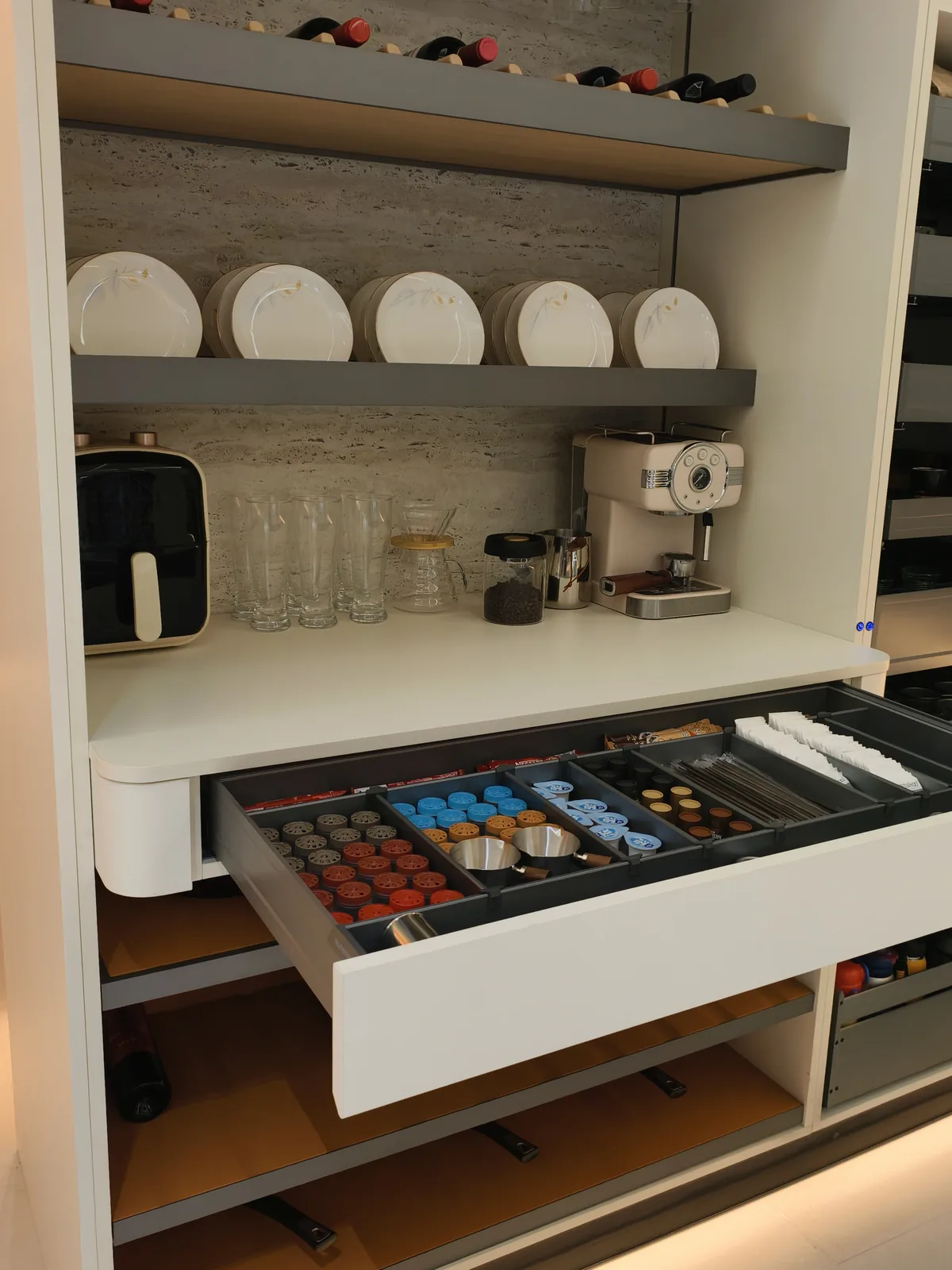
The drawer in the photograph above is the argument in one image: a capsule drawer sorted by colour, compartments cut to the capsule count. That layout did not come from a catalogue page - it came from a buyer saying which machine they owned and how many pods a week the house got through. A foam tray would have given that drawer two big empty cells and a lid that does not close.
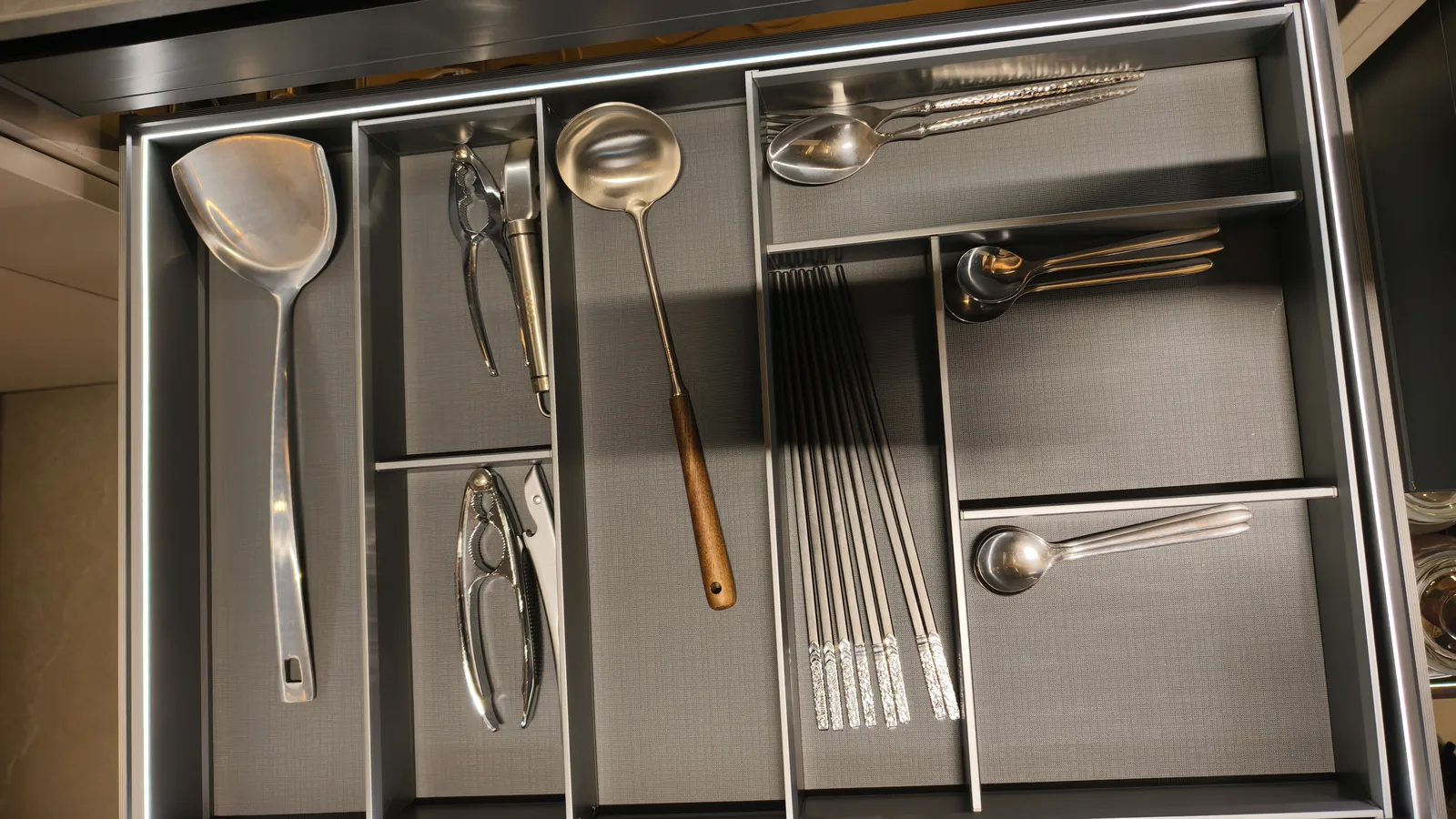
The second photograph is the same logic applied to cooking tools: compartments sized to the tools rather than to the drawer, so the wok spatula lies flat in its own run and the nutcracker does not wander.
The runner question
Dividers change what a drawer carries, and buyers reasonably ask whether the hardware changes with them. It does not.
Yes - every drawer ships on full-extension soft-close runners rated 35-45 kg per pair, with soft-close hardware tested to 50,000 cycles, loaded or empty.
The load rating matters more in a divided drawer than an open one, because a divided drawer is the one that ends up holding the heavy things: the cast-iron pan collection, the glass storage jars, the box of bin bags. Full extension matters because a half-open drawer hides the back row, and the back row is where the thing you want always is. The soft-close matters because a drawer loaded with glass is the loudest thing in a quiet kitchen when it slams.
The specs
The dividers are not a separate product line with a separate spec sheet:
- 18mm E0-grade plywood dividers (ENF on request), 2mm PVB hot-melt edge banding on every cut edge.
- Soft-close hinges and runner sets tested to 50,000 cycles.
- Full-extension runners rated 35-45 kg per pair.
- 32mm system hole pattern - 32mm pitch, 5mm bores, 37mm setback - so drawer fronts, dividers and accessories are positioned off the same jig as the rest of the run.
- The dividers themselves: The same 18mm E0-grade plywood as the carcass, with 2mm PVB hot-melt edge banding on every cut edge - no exposed raw ply edge inside a drawer.
Lead time is the question that follows, and the honest answer is that organizers add nothing to it. The dividers are cut in the same pass as the carcass parts, banded in the same machine pass, and assembled on the same bench - a divided drawer is a drawing note, not an extra operation. Project lead times are quoted per order and spelled out in our lead-time guide. The run these drawers sit in is specified on the kitchen cabinets page, and the option list that includes them is on the cabinet options page.
Adding or changing organizers later
Kitchen drawer organizers can be added after the cabinets arrive, within limits: the carcasses accept new dividers later, because they are pinned rather than glued - but a drawer already cut for a different layout may need its base re-drilled, so it is cheaper to decide before the boxes are built.
In practice this means two things. If you buy the kitchen and the drawer list changes before production, the layout is redrawn at no cost beyond the drawing round. If the kitchen has been in use for two years and you want a different split, the dividers lift out and new ones can be pinned into the same base - provided the existing groove pattern still suits, and if it does not, a replacement base is a small cut-and-drill job rather than a new drawer. What we cannot do cheaply is move a compartment wall to a position the base was never drilled for, which is why we push the list conversation to the drawing stage instead of the delivery date.
What we quote
Kitchen drawer organizers are not a line item with a published price, for the same reason the cabinets are not: the layout is cut to your list. Kitchen quotes are issued per linear foot, duty-paid, against the final drawing, with the compartment layouts attached to the drawing so you can see exactly what each drawer will hold before you approve it. If a competing quote shows a per-drawer organizer price without a layout attached, that price is for a nominal drawer, not yours.
Where the photos came from
The drawers photographed on this page were shot in our partner's showroom, not rendered and not staged on a customer site - they are the same divided drawers our drawings specify, photographed loaded. Renderings used elsewhere on the site are labelled as renderings.
FAQ
What are kitchen drawer organizers?
Factory-cut dividers inside a drawer, edged and pinned like the carcass, sized to the box and to what you keep in it - not a foam tray bought to a nominal size.
Are factory-built drawer organizers better than aftermarket inserts?
For a fitted kitchen, yes: our dividers are cut to the internal dimension of your box and pinned to the base, so they do not shift, and they travel with the drawer instead of arriving as a separate shipment.
How do you decide the divider layout?
From your list: you send what goes in each drawer, and we draw the compartments to that list - cutlery in one run, cooking tools in another, spice jars and capsules where the count says they belong.
What material are the dividers?
The same 18mm E0-grade plywood as the carcass, with 2mm PVB hot-melt edge banding on every cut edge - no exposed raw ply edge inside a drawer.
Do organizer drawers still get soft-close runners?
Yes - every drawer ships on full-extension soft-close runners rated 35-45 kg per pair, with soft-close hardware tested to 50,000 cycles, loaded or empty.
Can organizers be added after the cabinets arrive?
The carcasses accept new dividers later, because they are pinned rather than glued - but a drawer already cut for a different layout may need its base re-drilled, so it is cheaper to decide before the boxes are built.


