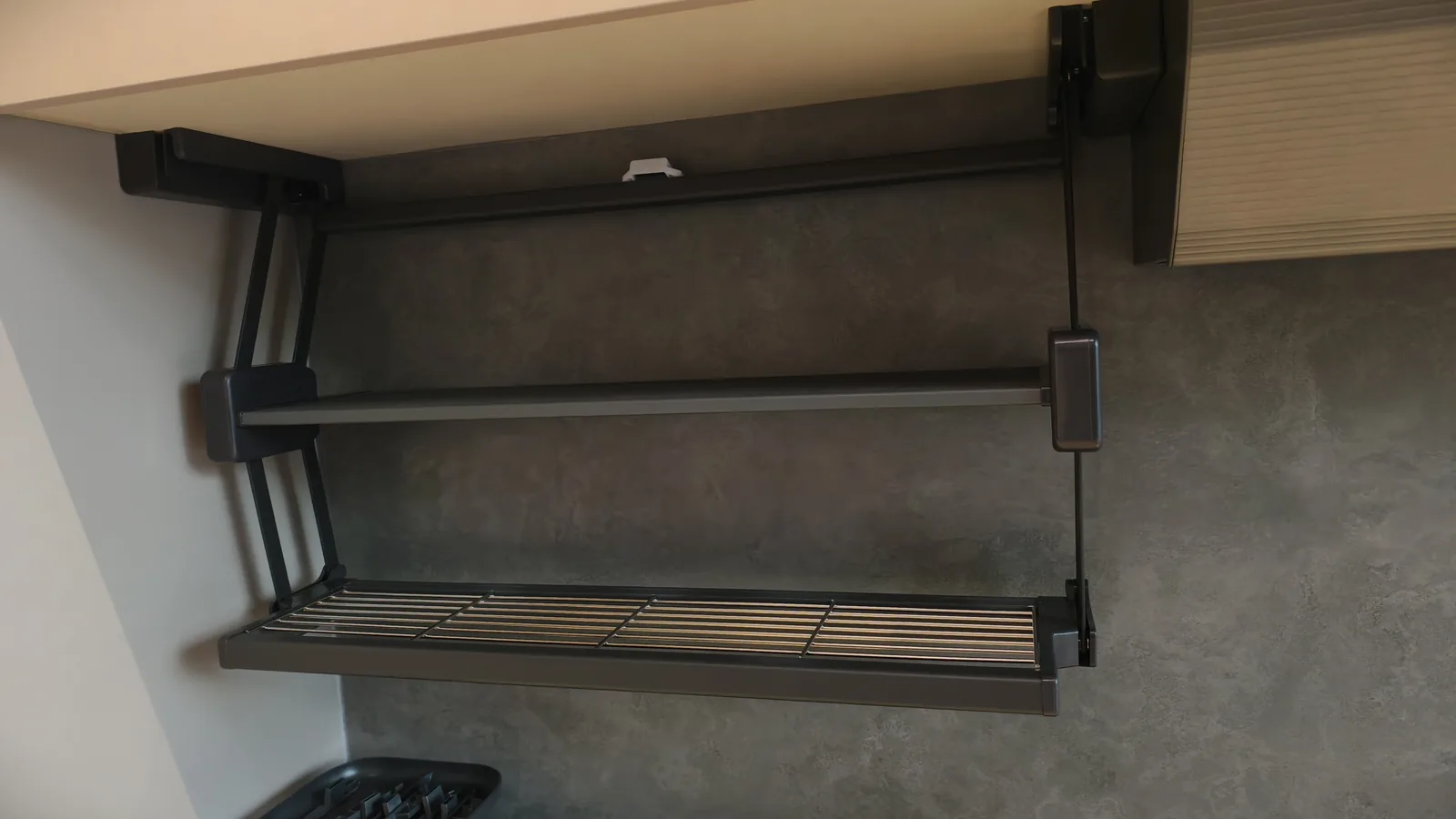
Pull-down shelves for wall cabinets are the fitting buyers over-order most often, and the photograph at the top of this page is one with nothing on it - which is the only way to explain it honestly. Strip the jars off and what is left is a scissor mechanism: two arms pivoted at the middle, one end mounted to the cabinet side, the other carrying the shelf. Pull the front down and the arms fold; the shelf travels in an arc, out of the cabinet and down, until it parks at working height. Push it back and the arms extend, and the shelf ends up flush inside the cabinet where it started.
That is the whole idea. The back row of a tall wall cabinet is the worst real estate in a kitchen: you can see it, you cannot reach it, and anything stored there gets moved to the front the first time you need it. The mechanism turns that dead zone into a shelf you can actually load.
The short version
- What it is: Pull-down shelves for wall cabinets hang on a scissor mechanism, mounted to the cabinet sides, that swings down and parks at working height.
- What it fixes: the back row of cabinets above counter height, in the run you open every day.
- What it costs: a mechanism per shelf, drilled into the cabinet sides at the factory - it cannot be retrofitted without new sides.
- When to skip it: cabinets below the counter line, cabinets used a few times a year, and shallow cabinets where the travel has nowhere to go.
What pull-down shelves for wall cabinets actually do
A pull-down shelf in a wall cabinet is a shelf hung on a scissor mechanism that swings down out of the cabinet and stops at working height, so the back row of a tall wall cabinet is reachable without a step stool.
The mounting is the part that decides whether it works. The mechanism bolts to the cabinet sides through the same 32mm system hole pattern the rest of the run is drilled on - 32mm pitch, 5mm bores, 37mm setback - which is why a pull-down shelf has to be a factory decision. The holes are not a convenience; they are what the mechanism hangs from, and a cabinet drilled without them cannot carry one.
The shelf itself is usually a wire basket rather than a solid panel, and the reason is in the photograph: a basket drains, it lets you see what is on the row below, and it weighs a fraction of a plywood shelf - which matters, because the mechanism is lifting the shelf and everything on it. Solid-shelf versions exist and we build them where the load is light and the spill risk is high, but for jars, plates and the things people actually put in wall cabinets, the basket is the default.
Travel is set at drawing stage, not on site, and it goes on the drawing next to the cabinet height. The travel is set at drawing stage so the lowered shelf front parks where you can see into it - our default is just above the counter line - and the shelf returns fully inside the cabinet when closed. Set the travel too low and the shelf front hits the backsplash or the tap; too high and you are still reaching. Both failures are drawing failures, which is why the travel dimension goes on the drawing next to the cabinet height.
How much it holds
The units we build are specced on the same lift mechanisms and full-extension runners rated 35-45 kg per pair as our drawer runners - a loaded basket of jars or a stack of plates sits well inside that envelope.
Two loads matter, and they are not the same. The static load is the shelf parked and loaded: the basket, the jars, whatever you pull out and put back. The dynamic load is the shelf in motion, and it is the harder one, because a half-lowered shelf is a lever - the weight out at the front is trying to fold the arms, and a mechanism that holds 20 kg parked will feel alarming at 10 kg if it is mid-travel with no damping. This is why we spec the same runner family as the drawer banks rather than a lighter accessory mechanism: the ratings we publish for the run apply to the pull-down too, and you can compare them against any other factory's numbers.
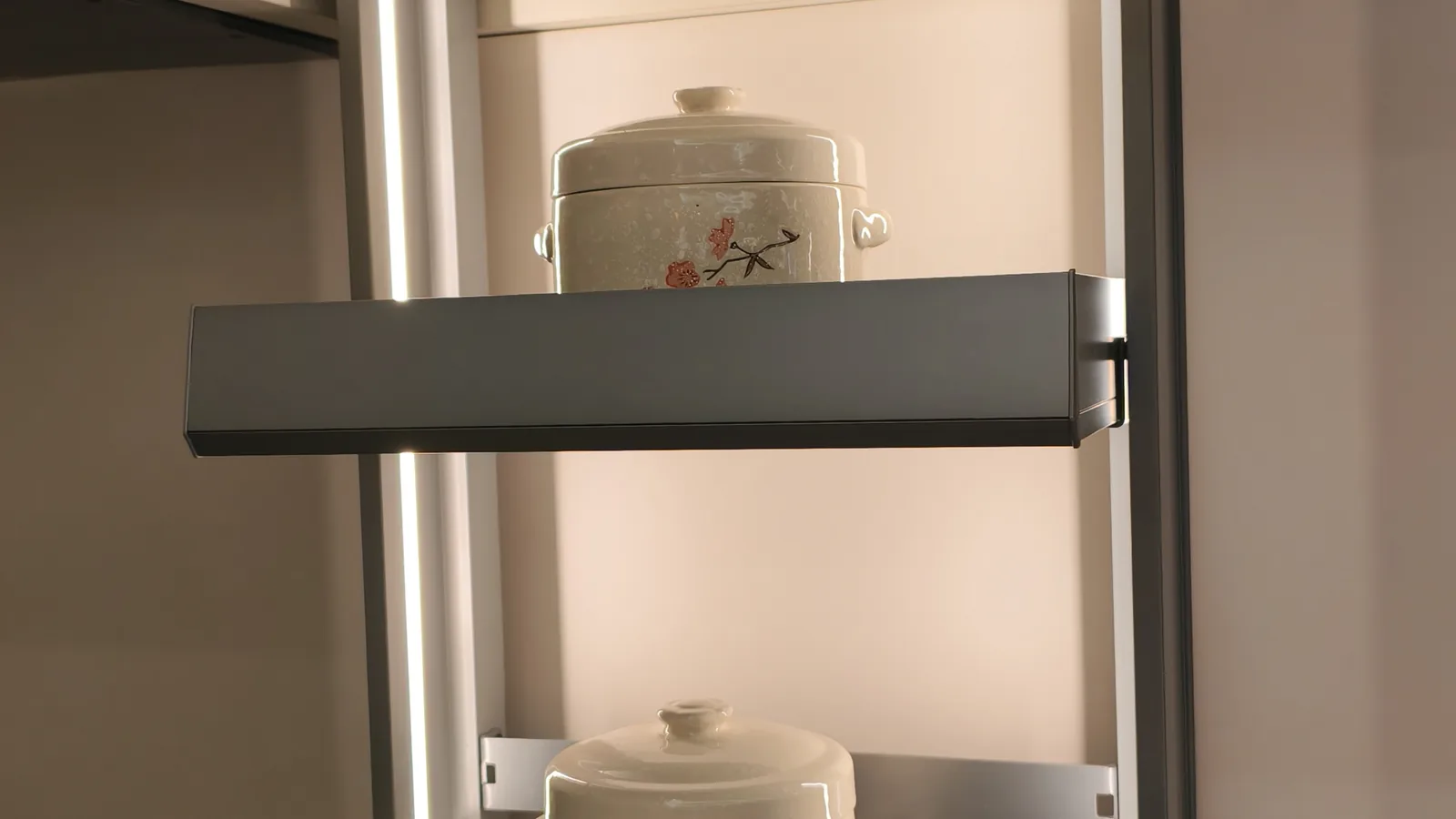
A useful sanity check from the showroom floor: the loaded basket in the photograph carries a covered ceramic stew pot - a single heavy object, the kind that ends a lesser mechanism. If what you plan to store is heavier than a stew pot, say so at drawing stage and we will spec a solid shelf on a heavier unit or talk you out of the pull-down entirely.
Where it earns the cost
The frequency test decides where pull-down shelves for wall cabinets earn their keep. They pay for themselves in the cabinets you open daily above the counter; in cabinets used a few times a year, or already within reach, a fixed shelf is the better buy.
The honest way to decide is frequency, not aesthetics. Walk your kitchen routine: the cabinet over the kettle, the one over the coffee machine, the spice run beside the hob - those get opened every day, and everything above eye level in them is currently reached on tiptoe or by feel. Those are the cabinets where the mechanism converts a daily annoyance into a one-hand reach.
The second-earning case is heavy daily items. Flour, rice, the oil you cook with, the good plates - the things that are too heavy to want at head height and too frequent to want in the base cabinet. A pull-down basket turns the shelf above the counter into the heaviest shelf in the kitchen without making it the hardest one to reach.
Where it does not
The same logic marks the cabinets to leave alone. Decorative cabinets, the run above the fridge, the seasonal storage above the extractor: opened a few times a year, so the mechanism sits idle and you have paid for hardware that never works. Shallow cabinets are the other miss - if the internal depth cannot hold the shelf plus the travel, the lowered shelf fouls the counter or the doors beside it, and no drawing note fixes that after the box is cut.
There is also the case nobody prints in a catalogue: an accessible kitchen. For a household where reaching up is a genuine difficulty - an older buyer, a wheelchair user, a family with young children - the pull-down is not a convenience but the reason the kitchen works, and we would rather over-specify it than have a buyer choose it on our advice and regret the price. If that is the situation, say it in the first message; it changes the layout conversation.
The specs
Pull-down shelves are not a separate spec sheet - they hang on the same run as everything else:
- 18mm E0-grade plywood carcass (ENF on request), 2mm PVB hot-melt edge banding on every cut edge.
- Soft-close hardware tested to 50,000 cycles, on the same damped-return principle as the drawer runners.
- Full-extension runners and lift mechanisms rated 35-45 kg per pair.
- 32mm system hole pattern - 32mm pitch, 5mm bores, 37mm setback - the pattern the mechanism mounts through.
Do pull-down shelves come with soft-close? Yes - the units we build use the same soft-close hardware tested to 50,000 cycles as the rest of the run, so the shelf decelerates on the way back up.
The soft-close matters more here than in a drawer. A drawer slams shut and the runners absorb it; a pull-down shelf is a lever arm being pushed back into a box, and without damping the basket arrives at the top of its travel like a dropped tray. The damped return is the difference between a mechanism you use and one you carefully lower by hand - which is to say, one you stop using.
Retrofitting an existing cabinet
Only if the carcass was drilled for it: the mechanism mounts to the cabinet sides on the same 32mm system holes, so retrofitting means new sides, and a new box is usually cheaper than new sides.
Buyers with an existing run ask about pull-down shelves for wall cabinets weekly, and the answer is almost always no. The mounting holes are drilled into the sides before assembly; a finished cabinet has no access to them, and surface-mounting an accessory mechanism to a finished side is a repair, not a fitting. If the run is new to you and the pull-down matters, it is cheaper to have the box built right than to hang hardware on a box that was never drilled for it. The run these shelves hang in is specified on the kitchen cabinets page, and the option list that includes them is on the cabinet options page.
What we quote
Pull-down shelves are quoted as part of the run, per linear foot, duty-paid, against the final drawing, with the pull-down positions marked on the drawing so you can see which shelves come down before you approve it. We do not publish a per-shelf mechanism price, because the unit, the travel and the load rating are drawing decisions - and a factory quoting one number for all of them is quoting a nominal shelf, not yours.
Where the photographs came from
Both photographs on this page were taken in our partner's showroom, not rendered and not shot on a customer site: the mechanism shot at the top is the same unit as the loaded basket below it, photographed empty first so the arms and the wire shelf are visible. Renderings used elsewhere on the site are labelled as renderings.
FAQ
What is a pull-down shelf in a wall cabinet?
A shelf hung on a scissor mechanism that swings down out of the cabinet and stops at working height, so the back row of a tall wall cabinet is reachable without a step stool.
How much weight can a pull-down shelf hold?
The units we build are specced on the same lift mechanisms and full-extension runners rated 35-45 kg per pair as our drawer runners - a loaded basket of jars or a stack of plates sits well inside that envelope.
Are pull-down shelves worth it?
They pay for themselves in the cabinets you open daily above the counter; in cabinets used a few times a year, or already within reach, a fixed shelf is the better buy.
How far down does a pull-down shelf come?
The travel is set at drawing stage so the lowered shelf front parks where you can see into it - our default is just above the counter line - and the shelf returns fully inside the cabinet when closed.
Can a pull-down shelf be added to an existing cabinet?
Only if the carcass was drilled for it: the mechanism mounts to the cabinet sides on the same 32mm system holes, so retrofitting means new sides, and a new box is usually cheaper than new sides.
Do pull-down shelves come with soft-close?
Yes - the units we build use the same soft-close hardware tested to 50,000 cycles as the rest of the run, so the shelf decelerates on the way back up.