What the window covers when cabinets damaged in transit arrive
Most buyers meet the damage clause for the first time on the day cabinets damaged in transit come off the truck, which is the worst possible day to be reading a contract. By then the pallet is already on the ground, the driver has gone, and the crate that arrived with a crushed corner has been opened because everyone wants to see what is inside. That sequence - open first, document later - is the single most common way a valid claim gets thrown out.
The 48-hour window is not a customer-service courtesy. It is the evidence window that the insurance claim lives or dies inside. This article explains what the window actually covers, what it does not, who carries the risk on a duty-paid order, and how the packing is built so that the question never comes up.
What the window is actually for
When cabinets damaged in transit reach your dock, two things have to be established, and only one of them is about the damage itself. The first is the fact of damage: what is broken, where, and how badly. The second is causation - that the damage happened during carriage rather than at your site, in your warehouse, or during your own install crew's unload. The second is the one that fails, and it fails for a boring reason: nobody preserved the evidence.
Cargo insurance is a proof-based product. The insurer did not see the container being crushed in a stack at Long Beach, did not see the forklift tine through the carton, and did not see the crate that arrived already dented. All the insurer has is what the claimant can show. A policy pays out on photographs, the packing list, the bill of lading notation, and the timeline of when those were produced. It does not pay out on a description, however accurate.
That is the entire logic of the window. Everything you do inside 48 hours is about converting "it arrived broken" into "it arrived broken, here is the proof, and I preserved the goods for inspection."
What you have to do inside 48 hours
The steps are short, and they are worth doing even if you decide not to claim.
| Step | What to do | Why it matters |
|---|---|---|
| 1. Photograph before opening | Whole crate or carton in place, on the pallet, before a seal is broken | Establishes the condition on arrival, not after handling |
| 2. Photograph the marks | Crush points, punctures, water staining, tilt or shock indicators | Points to the cause and the leg where it happened |
| 3. Note it on the delivery receipt | Write the damage on the driver's copy before signing | A clean signed receipt is read as "received in good order" |
| 4. Open and photograph inside | Each damaged unit, the packaging around it, the part itself | Shows whether the packaging failed or the unit failed |
| 5. Keep the packaging | Do not discard the crate, straps or wrap until released | The packaging is the evidence of whether it did its job |
| 6. Report with the order number | Photos plus order number to the supplier within 48 hours | Ties the claim to the contract terms and the shipment |
Step 3 is the one buyers skip most often, and it is the one that costs the most. A delivery receipt signed without notation is treated as confirmation that the goods arrived in apparent good order. It does not matter that the crate was visibly crushed - if nothing was written down and the driver has left, the record says the opposite of what happened.
What the window does not cover
Three things sit outside the window, and buyers are often surprised by all three.
Concealed damage. A hairline crack in a lacquered door that only shows when the door is hung and the light hits it is not visible at delivery. Most marine cargo policies allow a separate, longer notification period for concealed damage, but it is not automatic and it is not the same 48 hours. Read the policy, not the packaging.
Normal transit marks. Scuffed carton corners and compression dents in corrugate are what packaging is for. A claim that asks the insurer to replace a unit because its carton is dented, when the unit inside is undamaged, is not a damage claim - it is a packaging claim, and it will be declined.
Anything after acceptance. Once units are installed, cut to fit, drilled for plumbing, or fitted into an opening, the ability to return them to the supplier as stock is gone. Damage found at that point is a workmanship and replacement conversation, not a freight claim.
| Type | Notification | Evidence that works | Typical outcome |
|---|---|---|---|
| Visible damage | Immediately, and within the contractual window | Photos before opening, noted delivery receipt, retained packaging | Insurance claim plus replacement parts |
| Concealed damage | As soon as found, within the policy's concealed-damage period | Photos at discovery, install date records, retained packaging | Claim, if the policy allows it |
| Packaging-only damage | No claim needed | Photos for the supplier's records | No claim, no replacement |
| Post-installation damage | Not a freight claim | Site records, install date | Handled as replacement parts, not insurance |
Who carries the risk on a duty-paid order
This is where the terms matter more than the packing. Under a duty-paid price, the quote covers production, crating, ocean freight, insurance, customs clearance, duty and the delivery leg through to your door. The insurance line in that stack is real: an insurance certificate assures the consignee that the cargo is covered for loss or damage during transit, and it is normally obtained through the freight forwarder or the insurance carrier.
But the Incoterms rules that define who carries which cost and which risk are a framework, not a verdict. They allocate responsibility between seller and buyer for the delivery of goods; they do not decide, on their own, what an insurer will pay on a specific loss. That is set by the insurance policy and the contract behind it, and the policy will always ask for the same thing: notice, and proof.
So on a duty-paid order the practical division is this. The supplier arranges and pays for the cover, and is the party that pursues the insurer. The consignee is the party that has to generate the notice and the evidence, because the consignee is the one standing at the dock when the crate is opened. If the notice is late, the supplier cannot recover from the insurer either - the claim dies at the evidence stage, not at the liability stage.
That is why our contract states the window plainly rather than burying it: report within 48 hours of delivery, with photos and the order number. It is in the contract, not a suggestion. Replacement parts ship by courier from US stock where available, or with the next container.
How the packing is built to survive the ocean leg
The honest answer to "how do I stop this happening" is that you cannot eliminate it - you can only shrink the probability and make the recovery fast. Both are engineering problems. Most cabinets damaged in transit are damaged by compression or impact inside a container that was loaded correctly but braced for a different cargo, so the fixes are all about restraint and about giving a fragile panel somewhere to go when the load shifts.
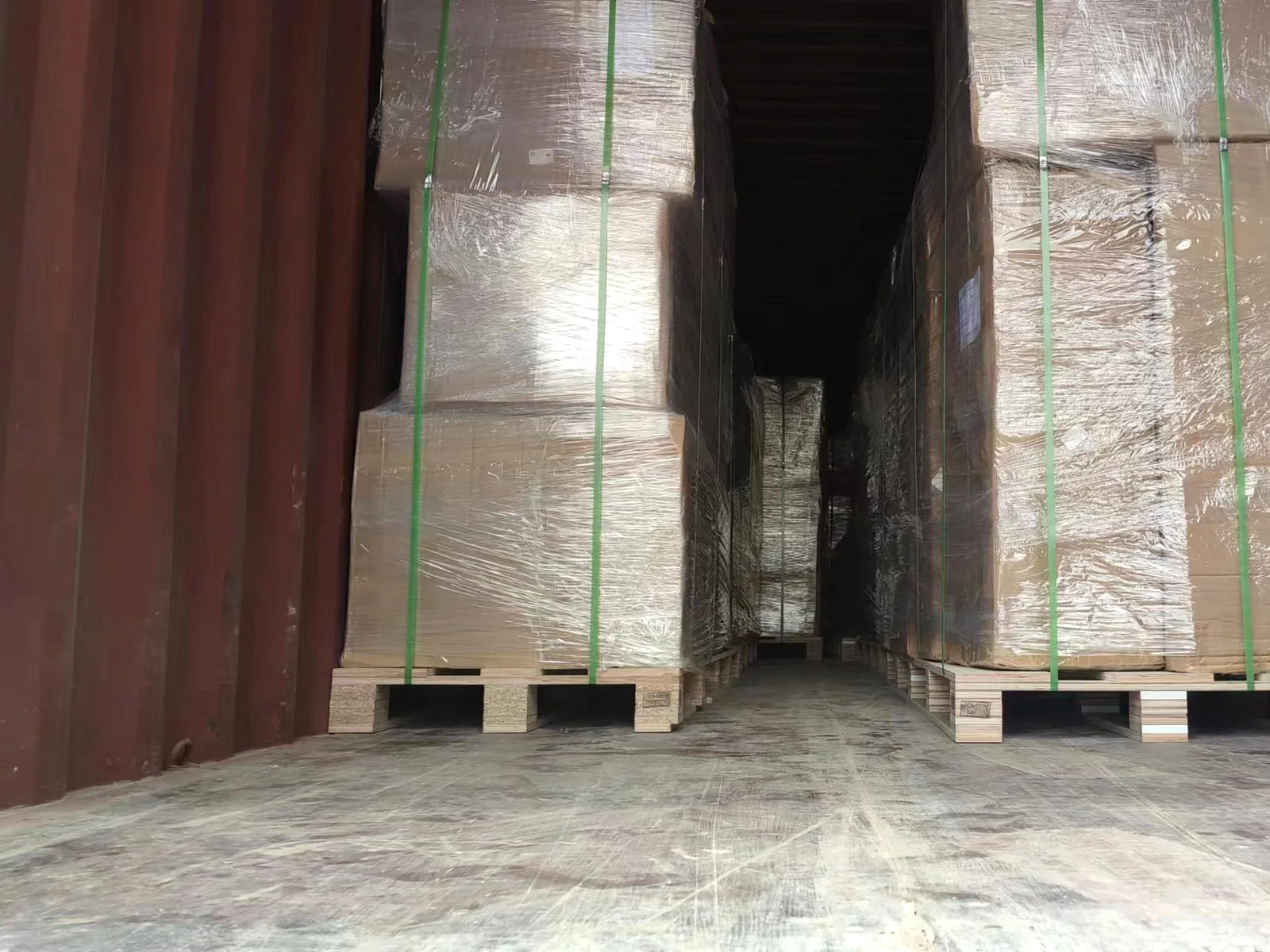
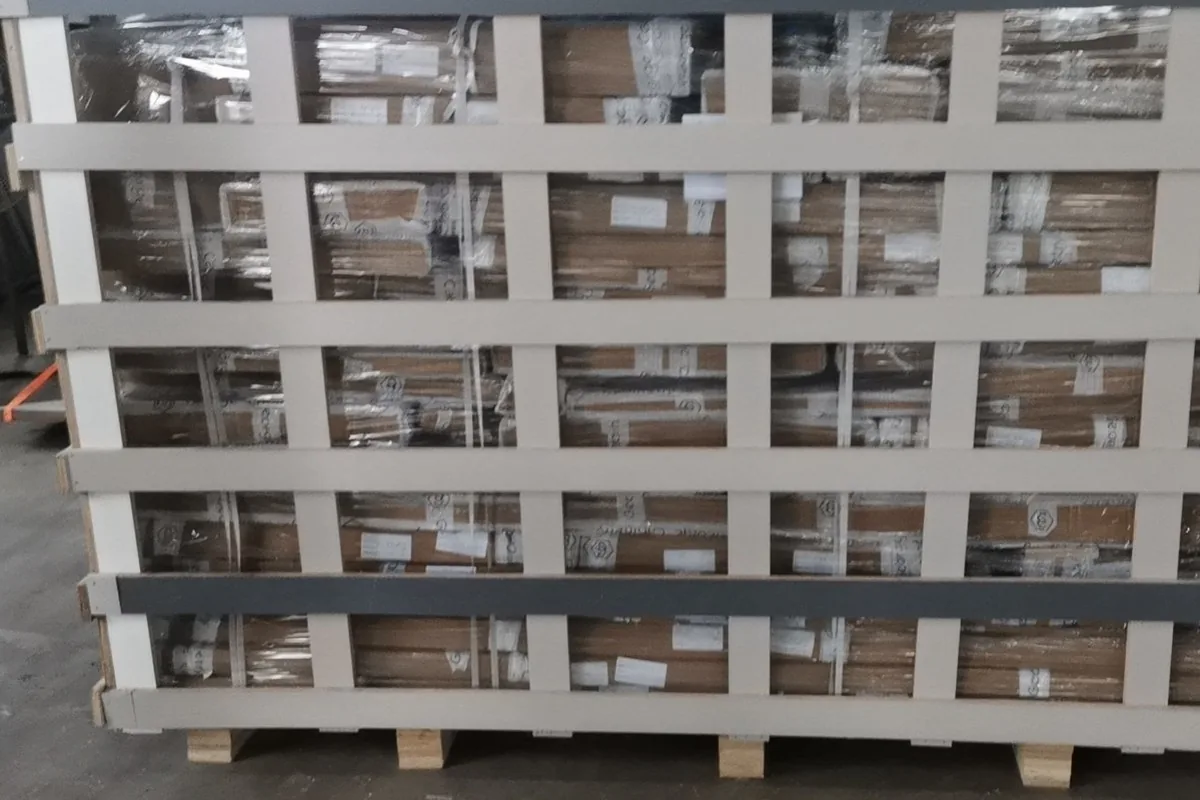
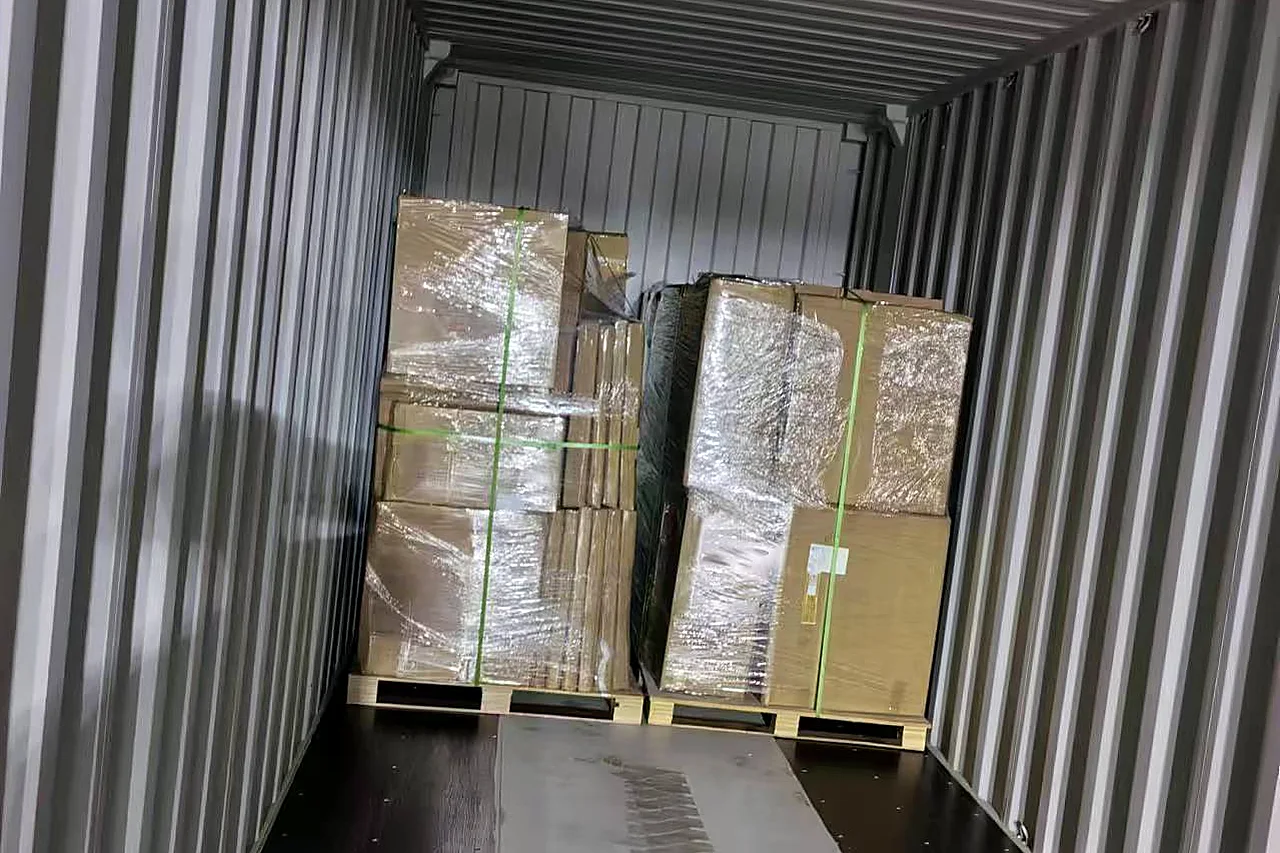
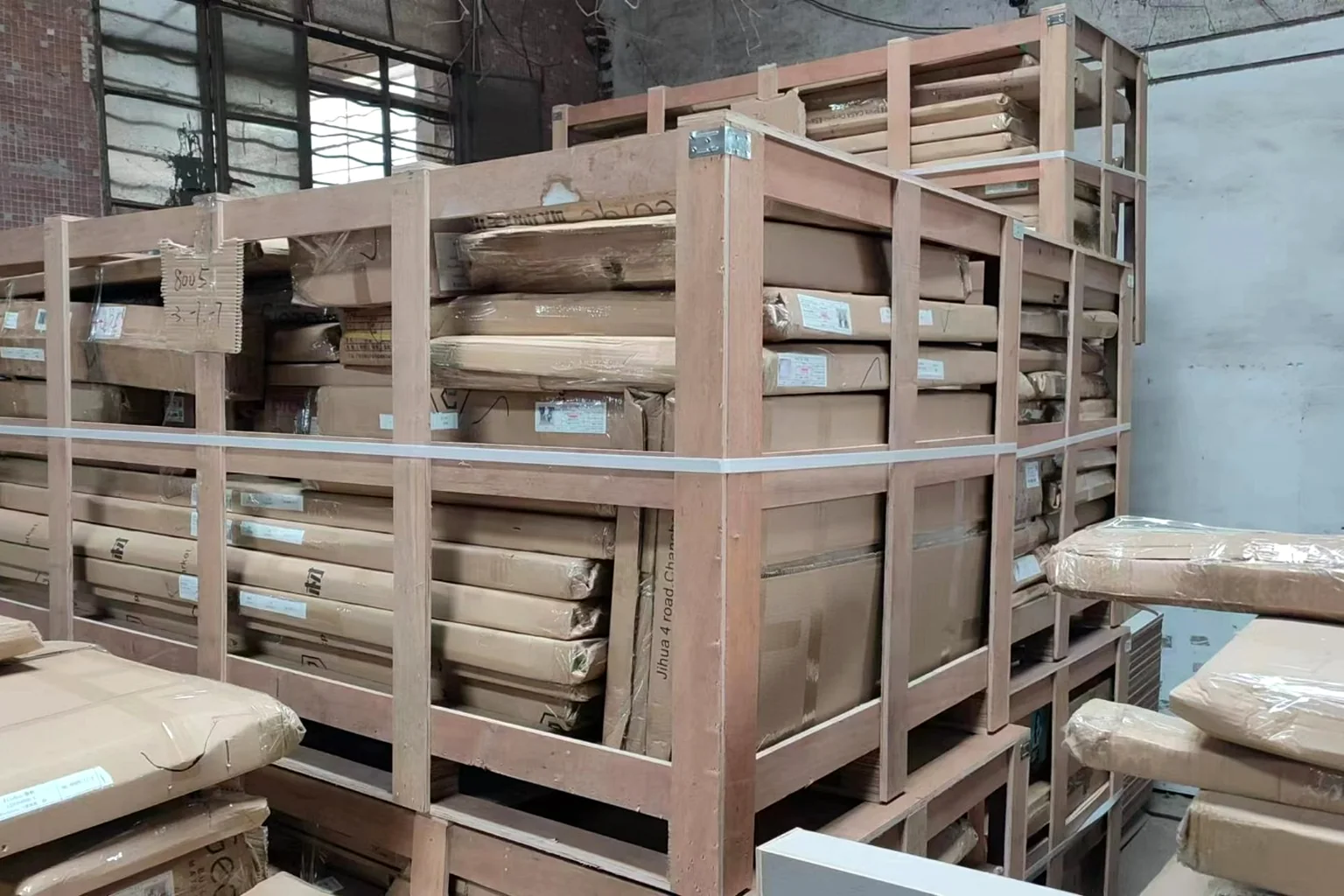
Pallets are stacked to the container's internal bay dimensions, not to whatever shape is convenient, so that the load does not shift into the doors. Strapping is run over the wrap rather than through it, so that the wrap is doing the weather protection and the straps are doing the restraint - a strap that cuts into the film holds the load but leaves it exposed. Corner posts and top frames take the compression that a plain stack would transfer straight into the doors. Glass, mirrored and stone components go in their own vertical crates, because a stone top laid flat under a stack is a cracked stone top.
Every pallet is photographed before the container doors close, and the packing list carries the gross weight per pallet, so that a pallet arriving light is a question the records can answer without opening anything.
What we do on our side
A damage claim is a joint process, and the parts a supplier controls are all upstream. Each order is fully trial-assembled on the bench before packing, with photo reports at 24 hours (cut parts and edge banding), 48 hours (finishing and hardware) and 72 hours (trial assembly and packing review). If a checkpoint photo shows something you do not accept, production pauses and the part is reworked before the crate is sealed. A unit that leaves the factory already right does not become a claim at the far end.
The loading is documented the same way. You get photographs of the container as it is loaded and before the doors close, which means that if damage is found on arrival, the comparison is between two known states rather than between a crate and a memory.
Replacement parts are held in US stock for the components that actually break in transit - hinges, runners, glass and stone. That is the difference between a three-week repair and a same-week one.
The short version
If cabinets damaged in transit arrive at your site, do these four things and do them in this order: photograph the crate before you open it, write the damage on the delivery receipt before you sign, keep every piece of the packaging, and send the photos plus your order number within 48 hours. The window is not there to give the supplier time to think. It is there because the insurance claim needs evidence that only you can produce, and after 48 hours that evidence is gone.
What should I do if cabinets arrive damaged?
Photograph the crate or pallet before opening anything, note the damage on the delivery receipt before signing, then open and photograph each affected unit. Send the photos with your order number within 48 hours of delivery and keep all packaging until the claim is released.
Does the 48-hour window apply to concealed damage?
Not usually. Concealed damage - a crack that only shows when the unit is installed - normally falls under a separate, longer notification period in the insurance policy. The policy governs, not the packing list, so read the terms before you assume you are out of time.
Who pays if the damage happened at sea?
On a duty-paid order the insurance is arranged and paid for by the supplier, so the recovery is pursued on your behalf. But the claim still depends on your notice and your photographs, because the insurer only pays against evidence. Without them there is nothing to recover.
Does flat-pack reduce transit damage?
It reduces some kinds and increases others. Flat-pack removes finished-case handling damage and packs more efficiently, but it means more small cartons, more edges exposed and more places to count. Assembled crates protect a finished unit as one object. The comparison is in the flat-pack versus assembled guide.
What photos does a claim need?
Six sets: the pallet as delivered, the damage to the packaging, the noted delivery receipt, each damaged unit, the packaging immediately around the damage, and the packing list or order paperwork. Wide shots first, close-ups second, so the location is unambiguous.
Can you send replacement parts quickly?
For hinges, runners, glass and stone, yes - those are held in US stock and ship by courier. Full replacement units go with the next container. Which of the two applies is set by what the claim covers, not by what would be fastest.
FAQ
What should I do if cabinets arrive damaged?
Photograph the crate or pallet before opening anything, note the damage on the delivery receipt before signing, then open and photograph each affected unit. Send the photos with your order number within 48 hours of delivery and keep all packaging until the claim is released.
Does the 48-hour window apply to concealed damage?
Not usually. Concealed damage - a crack that only shows when the unit is installed - normally falls under a separate, longer notification period in the insurance policy. The policy governs, not the packing list, so read the terms before you assume you are out of time.
Who pays if the damage happened at sea?
On a duty-paid order the insurance is arranged and paid for by the supplier, so the recovery is pursued on your behalf. But the claim still depends on your notice and your photographs, because the insurer only pays against evidence. Without them there is nothing to recover.
Does flat-pack reduce transit damage?
It reduces some kinds and increases others. Flat-pack removes finished-case handling damage and packs more efficiently, but it means more small cartons, more exposed edges and more places to count. Assembled crates protect a finished unit as one object.
What photos does a claim need?
Six sets: the pallet as delivered, the damage to the packaging, the noted delivery receipt, each damaged unit, the packaging immediately around the damage, and the packing list or order paperwork. Wide shots first, close-ups second, so the location is unambiguous.
Can you send replacement parts quickly?
For hinges, runners, glass and stone, yes - those are held in US stock and ship by courier. Full replacement units go with the next container. Which of the two applies is set by what the claim covers, not by what would be fastest.